menu

Hereford, AZ

This is a small community in a single neighborhood. As throughout the site, some neighborhood-level data are reserved for subscribers.


Overview

Hereford is a very small town located in the state of Arizona. With a population of 4,889 people and just one neighborhood, Hereford is the 76th largest community in Arizona. Much of the housing stock in Hereford was built relatively recently. The construction of new real estate can often be taken as an indication that the local Hereford economy is robust, and that jobs or other amenities are attracting an influx of new residents. This seems to be the case in Hereford, where the median household income is $82,308.00.

Occupations and Workforce

Unlike some towns where white-collar or blue-collar occupations dominate the local economy, Hereford is neither predominantly one nor the other. Instead, it has a mixed workforce of both white- and blue-collar jobs. Overall, Hereford is a town of sales and office workers, professionals, and managers. There are especially a lot of people living in Hereford who work in office and administrative support (14.41%), sales jobs (11.76%), and management occupations (8.32%).

Also of interest is that Hereford has more people living here who work in computers and math than 95% of the places in the US.

One interesting thing about the economy is that relatively large numbers of people worked from their home: 13.82% of the workforce. While this number may seem small overall, as a fraction of the total workforce this is high compared to the rest of the county. These workers are often telecommuters who work in knowledge-based, white-collar professions. For example, Silicon Valley has large numbers of people who telecommute. Other at-home workers may be self-employed people who operate small businesses out of their homes.

Setting & Lifestyle

Residents will find that the town is relatively quiet. This is because it is not over-populated, and it has fewer college students, renters, and young children - all of whom can be noisy at times. So, if you're looking for a relatively peaceful place to live, Hereford is worth considering.

As is often the case in a small town, Hereford doesn't have a public transportation system that people use for their commute.

Demographics

The population of Hereford is very well educated relative to most cities and towns in the nation, where the average community has 21.84% of its adult population holding a 4-year degree or higher: 37.77% of adults in Hereford have a bachelor's degree or even advanced degree.

The per capita income in Hereford in 2022 was $40,777, which is upper middle income relative to Arizona and the nation. This equates to an annual income of $163,108 for a family of four. However, Hereford contains both very wealthy and poor people as well.

Hereford is a very ethnically-diverse town. The people who call Hereford home describe themselves as belonging to a variety of racial and ethnic groups. The greatest number of Hereford residents report their race to be White, followed by Black or African-American. Hereford also has a sizeable Hispanic population (people of Hispanic origin can be of any race). People of Hispanic or Latino origin account for 16.56% of the town’s residents. Important ancestries of people in Hereford include German, English, Irish, French, and Polish.

The most common language spoken in Hereford is English. Other important languages spoken here include Spanish and Italian.

Notable & Unique Neighborhood Characteristics

When you see a neighborhood for the first time, the most important thing is often the way it looks, like its homes and its setting. Some places look the same, but they only reveal their true character after living in them for a while because they contain a unique mix of occupational or cultural groups. This neighborhood is very unique in some important ways, according to NeighborhoodScout's exclusive exploration and analysis.

People

In a nation where 1 out of every 4 children lives in poverty, the neighborhood stands out as being ranked among the lowest 0.0% of neighborhoods affected by this global issue.

In addition, if you're nearing retirement age, or in retirement, the is an excellent choice for you to consider for top-quality retirement living. This neighborhood is rated by NeighborhoodScout as among the top 8.5% of retiree-friendly neighborhoods in Arizona, combining peace and quiet, safety from crime, and offering diverse housing options from which retirees can choose. Maybe it's because of these amenities that a large proportion of the residents here are college educated seniors, mixed with other age groups. For these and other reasons, NeighborhoodScout identifies this neighborhood as a top-notch place to consider if you are thinking of or planning to retire in Arizona.

Occupations

The neighborhood has a greater proportion of government workers living in it than 98.2% of the neighborhoods in America, according to NeighborhoodScout's exclusive analysis. This is a unique feature of this neighborhood, and one that shapes its character.

Real Estate

Owner-occupied real estate dominates the neighborhood. In fact, according to NeighborhoodScout research, the percentage of residential real estate occupied by its owner is higher here than in 97.1% of neighborhoods in America.

In addition, this neighborhood has wide open spaces, few people, and lots of space to stretch out. If you like locations that fit that description, you may like this neighborhood. Based on NeighborhoodScout's exclusive analysis, with only 22 people per square mile living here, this neighborhood is less crowded than 94.3% of America.

Diversity

Did you know that the neighborhood has more Dutch ancestry people living in it than nearly any neighborhood in America? It's true! In fact, 4.0% of this neighborhood's residents have Dutch ancestry.

The Neighbors

There are two complementary measures for understanding the income of a neighborhood's residents: the average and the extremes. While a neighborhood may be relatively wealthy overall, it is equally important to understand the rate of people - particularly children - who are living at or below the federal poverty line, which is extremely low income. Some neighborhoods with a lower average income may actually have a lower childhood poverty rate than another with a higher average income, and this helps us understand the conditions and character of a neighborhood.

The neighbors in the neighborhood in Hereford are middle-income, making it a moderate income neighborhood. NeighborhoodScout's exclusive analysis reveals that this neighborhood has a higher income than 55.5% of the neighborhoods in America. In addition, 0.0% of the children seventeen and under living in this neighborhood are living below the federal poverty line, which is a lower rate of childhood poverty than is found in 100.0% of America's neighborhoods.

A neighborhood is far different if it is dominated by enlisted military personnel rather than people who earn their living by farming. It is also different if most of the neighbors are clerical support or managers. What is wonderful is the sheer diversity of neighborhoods, allowing you to find the type that fits your lifestyle and aspirations.

In the neighborhood, 39.8% of the working population is employed in executive, management, and professional occupations. The second most important occupational group in this neighborhood is manufacturing and laborer occupations, with 23.1% of the residents employed. Other residents here are employed in sales and service jobs, from major sales accounts, to working in fast food restaurants (22.7%), and 17.0% in government jobs, whether they are in local, state, or federal positions.

Languages

The languages spoken by people in this neighborhood are diverse. These are tabulated as the languages people preferentially speak when they are at home with their families. The most common language spoken in the neighborhood is English, spoken by 89.3% of households. Other important languages spoken here include Spanish, Italian and Polish.

Ethnicity / Ancestry

Culture is shared learned behavior. We learn it from our parents, their parents, our houses of worship, and much of our culture – our learned behavior – comes from our ancestors. That is why ancestry and ethnicity can be so interesting and important to understand: places with concentrations of people of one or more ancestries often express those shared learned behaviors and this gives each neighborhood its own culture. Even different neighborhoods in the same city can have drastically different cultures.

In the neighborhood in Hereford, AZ, residents most commonly identify their ethnicity or ancestry as German (21.6%). There are also a number of people of English ancestry (19.5%), and residents who report Mexican roots (14.3%), and some of the residents are also of Irish ancestry (10.4%), along with some French ancestry residents (5.7%), among others.

Getting to Work

How you get to work – car, bus, train or other means – and how much of your day it takes to do so is a large quality of life and financial issue. Especially with gasoline prices rising and expected to continue doing so, the length and means of one's commute can be a financial burden. Some neighborhoods are physically located so that many residents have to drive in their own car, others are set up so many walk to work, or can take a train, bus, or bike. The greatest number of commuters in neighborhood spend between 15 and 30 minutes commuting one-way to work (50.5% of working residents), which is shorter than the time spent commuting to work for most Americans.

Here most residents (82.8%) drive alone in a private automobile to get to work. In a neighborhood like this, as in most of the nation, many residents find owning a car useful for getting to work.

Real Estate includes:
Average Home Values
Rental Market
Housing Market Details
Neighborhood Setting
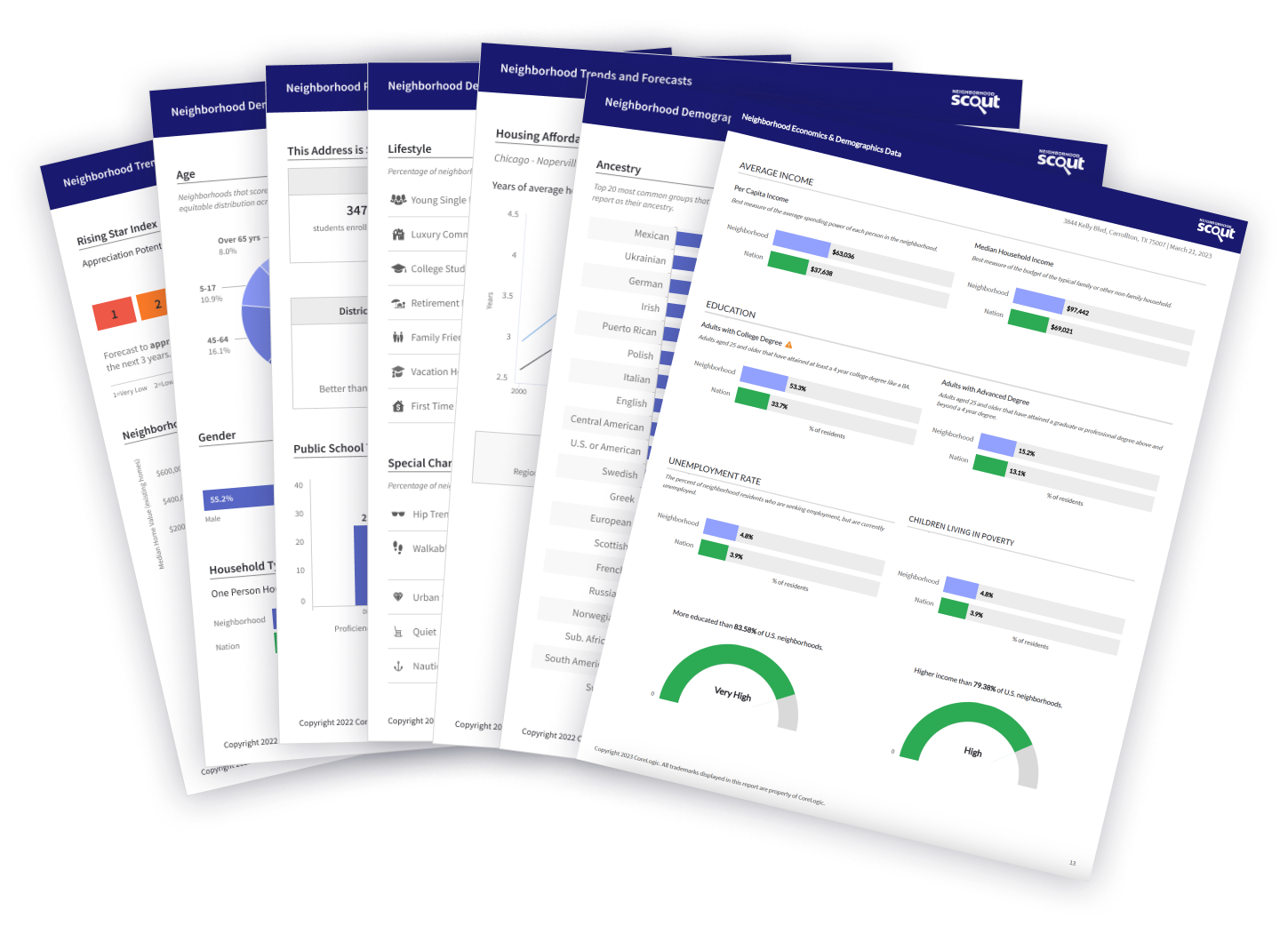
Economics & Demographics include:
Lifestyle & Special Character
Household Types
Commute To Work
Migration & Mobility
Race & Ethnic Diversity
Employment Industries & Occupations
Income & Unemployment Rate
Higher Education Attainment
Crime includes:
Neighborhood Crime Index
Crimes Per Square Mile
Property Crime Comparison
Violent Crime Comparison
Schools include:
School Ratings
Schools In District
Public School Test Scores
School District Enrollment
Educational Expenditures

comparable neighborhoods nearby