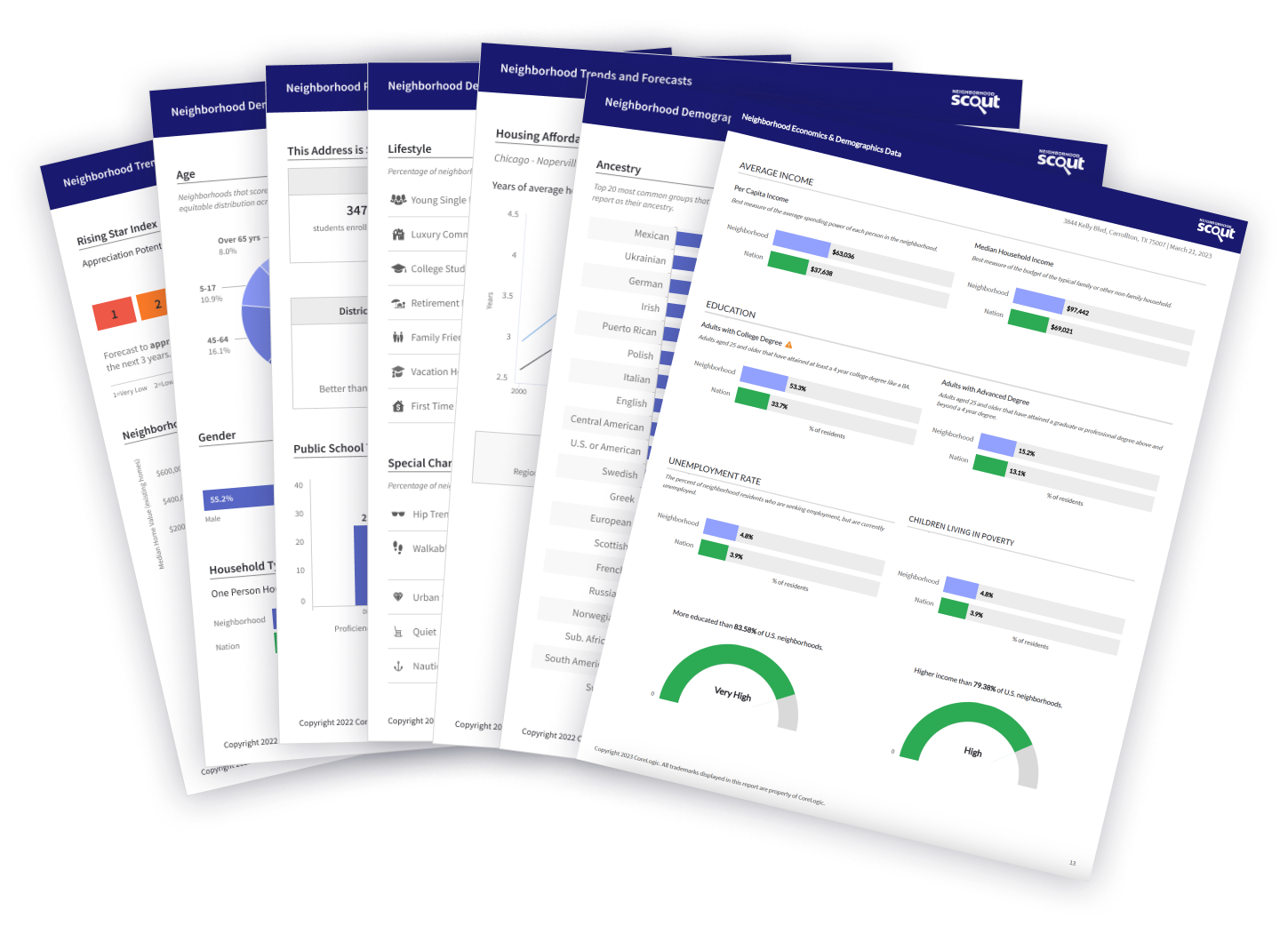
Penngrove is a very small town located in the state of California. With a population of 2,637 people and just one neighborhood, Penngrove is the 625th largest community in California.
Penngrove home prices are not only among the most expensive in California, but Penngrove real estate also consistently ranks among the most expensive in America.
Penngrove is a decidedly white-collar town, with fully 92.40% of the workforce employed in white-collar jobs, well above the national average. Overall, Penngrove is a town of professionals, managers, and sales and office workers. There are especially a lot of people living in Penngrove who work in management occupations (21.22%), healthcare (19.75%), and office and administrative support (18.59%).
And if you like science, one thing you'll find is that Penngrove has lots of scientists living in town - whether they be life scientists, physical scientists (like astronomers), or social scientists (like geographers!). So, if you're scientific-minded, you might like it here too.
Telecommuters are a relatively large percentage of the workforce: 13.98% of people work from home. While this number may seem small overall, as a fraction of the total workforce it is high relative to the nation. These workers are often telecommuters who work in knowledge-based, white-collar professions. For example, Silicon Valley has large numbers of people who telecommute. Other at-home workers may be self-employed people who operate small businesses out of their homes.
One downside of living in Penngrove is that it can take a long time to commute to work. In Penngrove, the average commute to work is 34.39 minutes, which is quite a bit higher than the national average.
Penngrove is a small town, and as such doesn't have a public transit system that people use to get to and from their jobs every day.
Do you like to read, write and learn? If you move to Penngrove, you'll likely find that many of your neighbors like to as well. Penngrove is one of the more educated communities in America, with a full 51.57% of its adults having a college degree or even advanced degree, compared to a national average across all communities of 21.84%.
The per capita income in Penngrove in 2022 was $84,058, which is wealthy relative to California and the nation. This equates to an annual income of $336,232 for a family of four.
Penngrove is a somewhat ethnically-diverse town. The people who call Penngrove home describe themselves as belonging to a variety of racial and ethnic groups. The greatest number of Penngrove residents report their race to be White, followed by Black or African-American. Important ancestries of people in Penngrove include Italian, English, German, Irish, and Scottish.
The most common language spoken in Penngrove is English. Other important languages spoken here include Langs. of India and Arabic.
When you see a neighborhood for the first time, the most important thing is often the way it looks, like its homes and its setting. Some places look the same, but they only reveal their true character after living in them for a while because they contain a unique mix of occupational or cultural groups. This neighborhood is very unique in some important ways, according to NeighborhoodScout's exclusive exploration and analysis.
In a nation where 1 out of every 4 children lives in poverty, the neighborhood stands out as being ranked among the lowest 0.0% of neighborhoods affected by this global issue.
In addition, astoundingly, the neighborhood has one of the highest concentrations of divorcees living here than of any neighborhood, a higher concentration than NeighborhoodScout found in 96.3% of U.S. neighborhoods. This may be because people living here divorce more often than others, or that divorced people move here after they become divorced. If you are divorced, you will be in good company in this particular Penngrove neighborhood.
Also, if you are planning to retire in California, this neighborhood should be on your must-see list. For many reasons, may be considered a retiree's dream neighborhood. According to NeighborhoodScout's exclusive analysis and metrics, it's peaceful and quiet, has above average safety from crime compared to other neighborhoods in California, while also offering a diverse range of housing options. This, along with the vibrant mix of very educated seniors and other age groups who choose to live here, makes the neighborhood more retiree-friendly than 95.3% of neighborhoods in CA. If a California retirement is in your future, this neighborhood should be one of the places you visit.
Would you like to be able to ride your bike to work? If you are attracted to the idea of getting a little exercise of the two-wheeled type while reducing your carbon footprint, bicycling to work might be the answer. But which neighborhood you live in can make this either impossible, or alternatively, a great and realistic option. NeighborhoodScout's analysis revealed that the neighborhood is a fantastic option for bicycle commuters, as 4.7% of commuters here do ride their bikes to and from work on a daily basis. This is a higher amount than we found in 98.0% of the neighborhoods in America.
Did you know that the neighborhood has more Swiss and Portuguese ancestry people living in it than nearly any neighborhood in America? It's true! In fact, 3.2% of this neighborhood's residents have Swiss ancestry and 3.2% have Portuguese ancestry.
How wealthy a neighborhood is, from very wealthy, to middle income, to low income is very formative with regard to the personality and character of a neighborhood. Equally important is the rate of people, particularly children, who live below the federal poverty line. In some wealthy gated communities, the areas immediately surrounding can have high rates of childhood poverty, which indicates other social issues. NeighborhoodScout's analysis reveals both aspects of income and poverty for this neighborhood.
The neighbors in the neighborhood in Penngrove are upper-middle income, making it an above average income neighborhood. NeighborhoodScout's exclusive analysis reveals that this neighborhood has a higher income than 71.1% of the neighborhoods in America. In addition, 0.0% of the children seventeen and under living in this neighborhood are living below the federal poverty line, which is a lower rate of childhood poverty than is found in 100.0% of America's neighborhoods.
The old saying "you are what you eat" is true. But it is also true that you are what you do for a living. The types of occupations your neighbors have shape their character, and together as a group, their collective occupations shape the culture of a place.
In the neighborhood, 49.8% of the working population is employed in executive, management, and professional occupations. The second most important occupational group in this neighborhood is sales and service jobs, from major sales accounts, to working in fast food restaurants, with 20.5% of the residents employed. Other residents here are employed in clerical, assistant, and tech support occupations (19.5%), and 10.2% in manufacturing and laborer occupations.
The most common language spoken in the neighborhood is English, spoken by 93.9% of households. Some people also speak Spanish (2.1%).
Boston's Beacon Hill blue-blood streets, Brooklyn's Orthodox Jewish enclaves, Los Angeles' Persian neighborhoods. Each has its own culture derived primarily from the ancestries and culture of the residents who call these neighborhoods home. Likewise, each neighborhood in America has its own culture – some more unique than others – based on lifestyle, occupations, the types of households – and importantly – on the ethnicities and ancestries of the people who live in the neighborhood. Understanding where people came from, who their grandparents or great-grandparents were, can help you understand how a neighborhood is today.
In the neighborhood in Penngrove, CA, residents most commonly identify their ethnicity or ancestry as Italian (20.2%). There are also a number of people of Irish ancestry (18.7%), and residents who report English roots (14.8%), and some of the residents are also of German ancestry (12.9%), along with some Mexican ancestry residents (11.3%), among others.
How you get to work – car, bus, train or other means – and how much of your day it takes to do so is a large quality of life and financial issue. Especially with gasoline prices rising and expected to continue doing so, the length and means of one's commute can be a financial burden. Some neighborhoods are physically located so that many residents have to drive in their own car, others are set up so many walk to work, or can take a train, bus, or bike. The greatest number of commuters in neighborhood spend between 45 minutes and one hour commuting one-way to work (34.4% of working residents), longer and tougher than most commutes in America.
Here most residents (61.1%) drive alone in a private automobile to get to work. In addition, quite a number also carpool with coworkers, friends, or neighbors to get to work (16.9%) . In a neighborhood like this, as in most of the nation, many residents find owning a car useful for getting to work.