menu

Willow Creek, CA

This is a small community in a single neighborhood. As throughout the site, some neighborhood-level data are reserved for subscribers.


Overview

Willow Creek is a very small town located in the state of California. With a population of 1,720 people and just one neighborhood, Willow Creek is the 683rd largest community in California.

Occupations and Workforce

Because occupations involving physical labor dominate the local economy, Willow Creek is generally considered to be a blue-collar town. 37.05% of the Willow Creek workforce is employed in blue-collar occupations, compared to the national average of 27.7%. Overall, Willow Creek is a town of construction workers and builders, service providers, and managers. There are especially a lot of people living in Willow Creek who work in maintenance occupations (17.77%), management occupations (11.13%), and teaching (10.49%).

And if you like science, one thing you'll find is that Willow Creek has lots of scientists living in town - whether they be life scientists, physical scientists (like astronomers), or social scientists (like geographers!). So, if you're scientific-minded, you might like it here too.

A relatively large number of people in Willow Creek telecommute to their jobs. Overall, about 23.68% of the workforce works from home. While this may seem like a small number, as a fraction of the total workforce it ranks among the highest in the country. These workers are often telecommuters who work in knowledge-based, white-collar professions. For example, Silicon Valley has large numbers of people who telecommute. Other at-home workers may be self-employed people who operate small businesses out of their homes.

Setting & Lifestyle

It is a fairly quiet town because there are relatively few of those groups of people who have a tendency to be noisy. (Children, for example, often can't help themselves from being noisy, and being parents ourselves, we know!) Willow Creek has relatively few families with children living at home, and is quieter because of it. Renters and college students, for their own reasons, can also be noisy. Willow Creek has few renters and college students. But the biggest reason it is quieter in Willow Creek than in most places in America, is that there are just simply fewer people living here. If you think trees make good neighbors, Willow Creek may be for you.

Compared to the rest of the country, citizens of Willow Creek spend much less time in their cars: on average, their commute to work is only 12.16 minutes. This also means that noise and pollution levels in the town are less than they would otherwise be.

Willow Creek is a small town, and as such doesn't have a public transit system that people use to get to and from their jobs every day.

Demographics

The education level of Willow Creek citizens is substantially higher than the typical US community, as 33.03% of adults in Willow Creek have at least a bachelor's degree.

The per capita income in Willow Creek in 2022 was $31,026, which is lower middle income relative to California and the nation. This equates to an annual income of $124,104 for a family of four. However, Willow Creek contains both very wealthy and poor people as well.

Willow Creek is a very ethnically-diverse town. The people who call Willow Creek home describe themselves as belonging to a variety of racial and ethnic groups. The greatest number of Willow Creek residents report their race to be White, followed by Native Hawaiian. Important ancestries of people in Willow Creek include English, Irish, German, Italian, and Polish.

The most common language spoken in Willow Creek is English. Other important languages spoken here include Italian and Native American languages.

Notable & Unique Neighborhood Characteristics

When you see a neighborhood for the first time, the most important thing is often the way it looks, like its homes and its setting. Some places look the same, but they only reveal their true character after living in them for a while because they contain a unique mix of occupational or cultural groups. This neighborhood is very unique in some important ways, according to NeighborhoodScout's exclusive exploration and analysis.

People

If you are planning to retire in California, this neighborhood should be on your must-see list. For many reasons, may be considered a retiree's dream neighborhood. According to NeighborhoodScout's exclusive analysis and metrics, it's peaceful and quiet, has above average safety from crime compared to other neighborhoods in California, while also offering a diverse range of housing options. This, along with the vibrant mix of very educated seniors and other age groups who choose to live here, makes the neighborhood more retiree-friendly than 98.9% of neighborhoods in CA. If a California retirement is in your future, this neighborhood should be one of the places you visit.

Real Estate

Uncrowded roads, rural America and space to be the individual you are. If you like these characteristics, this neighborhood may fit you. With just 4 residents per square mile, is less crowded than 98.6% of all U.S. neighborhoods.

In addition, despite all of the residential real estate here in the neighborhood, NeighborhoodScout has discovered that much of it is vacant. In resort or second-home vacation areas, this naturally occurs because homes and apartments are seasonally occupied, and empty for a portion of the year. In non-vacation or resort areas, however, this can be an indicator of property abandonment or a weak real estate market. The vacancy rate here is 34.1%, which is higher than 96.7% of all U.S. neighborhoods.

Modes of Transportation

In the neighborhood, walking to work is a real option for many. In fact, NeighborhoodScout's exclusive research reveals walking to and from work is the chosen way to commute for 11.7% of residents here. This is a higher proportion of walking commuters than we found in 95.9% of American neighborhoods. Get ready to put on your walking shoes if you move here!

Length of Commute

Regardless of the means by which residents commute, this neighborhood has a length of commute that is notable. Residents of the neighborhood have the pleasure of having one of the shortest commutes to work of any neighborhood in America. 57.6% of the residents have a commute time from home to work (one way) of less than fifteen minutes. This is a higher proportion of residents enjoying a short trip to work than NeighborhoodScout found in 95.2% of U.S. neighborhoods. Less time commuting means more time for other things in life.

Diversity

Did you know that the neighborhood has more Native American and Lithuanian ancestry people living in it than nearly any neighborhood in America? It's true! In fact, 14.2% of this neighborhood's residents have Native American ancestry and 1.8% have Lithuanian ancestry.

is also pretty special linguistically. Significantly, 9.3% of its residents five years old and above primarily speak Native American languages at home. While this may seem like a small percentage, it is higher than 99.8% of the neighborhoods in America.

The Neighbors

How wealthy a neighborhood is, from very wealthy, to middle income, to low income is very formative with regard to the personality and character of a neighborhood. Equally important is the rate of people, particularly children, who live below the federal poverty line. In some wealthy gated communities, the areas immediately surrounding can have high rates of childhood poverty, which indicates other social issues. NeighborhoodScout's analysis reveals both aspects of income and poverty for this neighborhood.

The neighbors in the neighborhood in Willow Creek are lower-middle income, making it a below average income neighborhood. NeighborhoodScout's research shows that this neighborhood has an income lower than 84.0% of U.S. neighborhoods. In addition, 8.9% of the children seventeen and under living in this neighborhood are living below the federal poverty line, which is a lower rate of childhood poverty than is found in 52.3% of America's neighborhoods.

A neighborhood is far different if it is dominated by enlisted military personnel rather than people who earn their living by farming. It is also different if most of the neighbors are clerical support or managers. What is wonderful is the sheer diversity of neighborhoods, allowing you to find the type that fits your lifestyle and aspirations.

In the neighborhood, 39.5% of the working population is employed in executive, management, and professional occupations. The second most important occupational group in this neighborhood is sales and service jobs, from major sales accounts, to working in fast food restaurants, with 27.3% of the residents employed. Other residents here are employed in manufacturing and laborer occupations (22.1%), and 10.1% in clerical, assistant, and tech support occupations.

Languages

The languages spoken by people in this neighborhood are diverse. These are tabulated as the languages people preferentially speak when they are at home with their families. The most common language spoken in the neighborhood is English, spoken by 98.6% of households. Other important languages spoken here include Native American languages and Italian.

Ethnicity / Ancestry

Culture is shared learned behavior. We learn it from our parents, their parents, our houses of worship, and much of our culture – our learned behavior – comes from our ancestors. That is why ancestry and ethnicity can be so interesting and important to understand: places with concentrations of people of one or more ancestries often express those shared learned behaviors and this gives each neighborhood its own culture. Even different neighborhoods in the same city can have drastically different cultures.

In the neighborhood in Willow Creek, CA, residents most commonly identify their ethnicity or ancestry as Native American (14.2%). There are also a number of people of Irish ancestry (14.0%), and residents who report English roots (13.7%), and some of the residents are also of German ancestry (11.2%), along with some Polish ancestry residents (5.7%), among others.

Getting to Work

Even if your neighborhood is walkable, you may still have to drive to your place of work. Some neighborhoods are located where many can get to work in just a few minutes, while others are located such that most residents have a long and arduous commute. The greatest number of commuters in neighborhood spend under 15 minutes commuting one-way to work (57.6% of working residents), one of the shortest commutes across America.

Here most residents (67.1%) drive alone in a private automobile to get to work. In addition, quite a number also hop out the door and walk to work to get to work (11.7%) and 7.7% of residents also carpool with coworkers, friends, or neighbors for their daily commute. In a neighborhood like this, as in most of the nation, many residents find owning a car useful for getting to work.

Real Estate includes:
Average Home Values
Rental Market
Housing Market Details
Neighborhood Setting
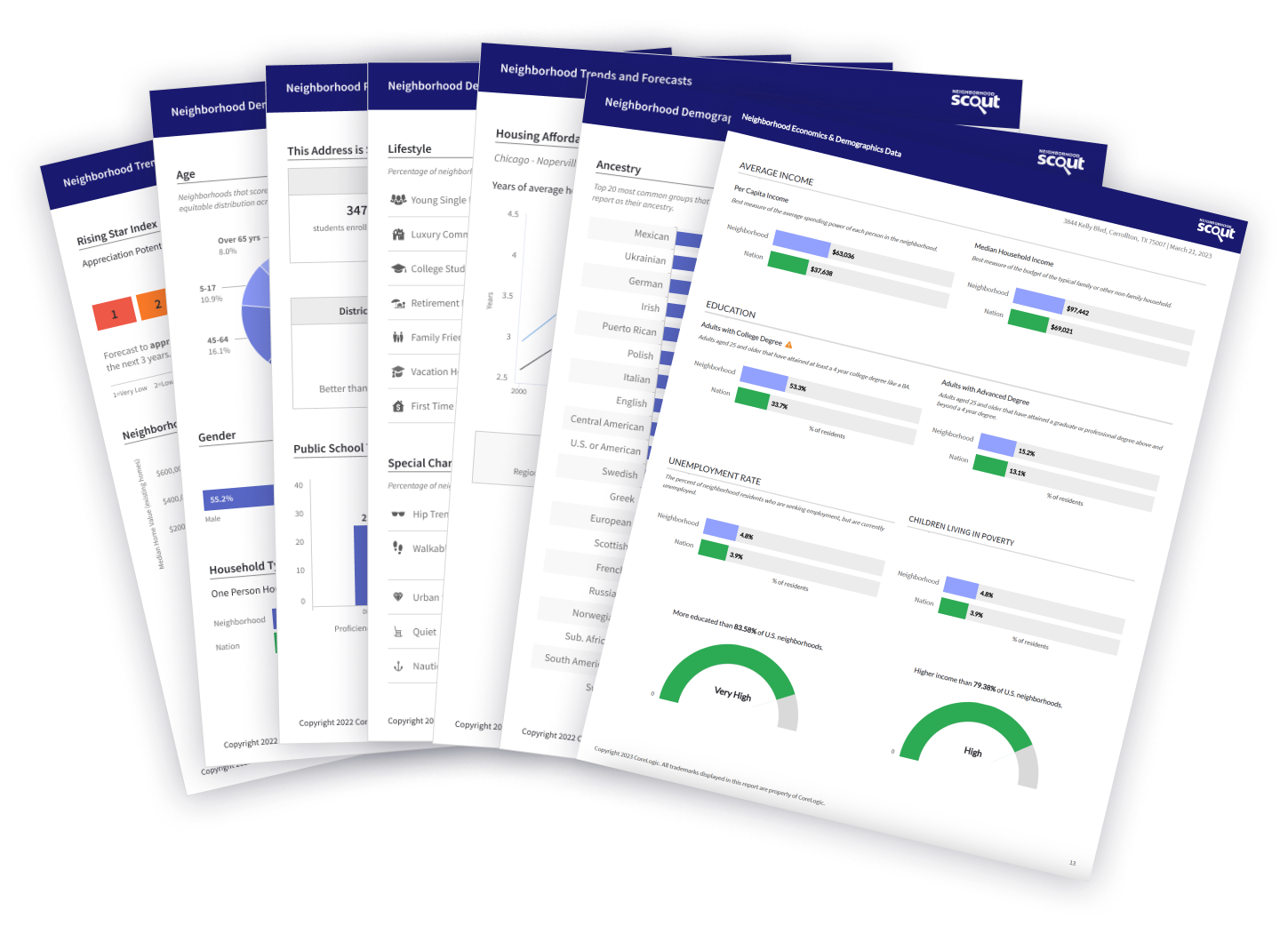
Economics & Demographics include:
Lifestyle & Special Character
Household Types
Commute To Work
Migration & Mobility
Race & Ethnic Diversity
Employment Industries & Occupations
Income & Unemployment Rate
Higher Education Attainment
Crime includes:
Neighborhood Crime Index
Crimes Per Square Mile
Property Crime Comparison
Violent Crime Comparison
Schools include:
School Ratings
Schools In District
Public School Test Scores
School District Enrollment
Educational Expenditures

Popular real estate nearby

comparable neighborhoods nearby