menu

West Branch, IA

This is a small community in a single neighborhood. As throughout the site, some neighborhood-level data are reserved for subscribers.


Overview


West Branch is a very small city located in the state of Iowa. With a population of 2,876 people and just one neighborhood, West Branch is the 218th largest community in Iowa. West Branch has seen a significant amount of newer housing growth in recent years. Quite often, new home construction is the result of new residents moving in who are middle class or wealthier, attracted by jobs, a healthy local economy, or other amenities as they leave nearby or far away areas for greener pastures. This seems to be the case in West Branch, where the median household income is $92,209.00.

West Branch real estate is some of the most expensive in Iowa, although West Branch house values don't compare to the most expensive real estate in the U.S.

Occupations and Workforce

Unlike some cities, West Branch isn’t mainly white- or blue-collar. Instead, the most prevalent occupations for people in West Branch are a mix of both white- and blue-collar jobs. Overall, West Branch is a city of sales and office workers, professionals, and service providers. There are especially a lot of people living in West Branch who work in sales jobs (13.65%), office and administrative support (13.31%), and healthcare (9.03%).

One interesting thing about the economy is that relatively large numbers of people worked from their home: 11.36% of the workforce. While this number may seem small overall, as a fraction of the total workforce this is high compared to the rest of the county. These workers are often telecommuters who work in knowledge-based, white-collar professions. For example, Silicon Valley has large numbers of people who telecommute. Other at-home workers may be self-employed people who operate small businesses out of their homes.

Setting & Lifestyle

Demographics

In terms of college education, West Branch is substantially better educated than the typical community in the nation, which has 21.84% of the adults holding a bachelor's degree or graduate degree: 31.91% of adults in West Branch have a college degree.

The per capita income in West Branch in 2022 was $42,486, which is upper middle income relative to Iowa and the nation. This equates to an annual income of $169,944 for a family of four. However, West Branch contains both very wealthy and poor people as well.

The people who call West Branch home describe themselves as belonging to a variety of racial and ethnic groups. The greatest number of West Branch residents report their race to be White, followed by Black or African-American. Important ancestries of people in West Branch include German, Irish, English, Czech, and Danish.

The most common language spoken in West Branch is English. Other important languages spoken here include Polish and Spanish.

Notable & Unique Neighborhood Characteristics

The way a neighborhood looks and feels when you walk or drive around it, from its setting, its buildings, and its flavor, can make all the difference. This neighborhood has some really cool things about the way it looks and feels as revealed by NeighborhoodScout's exclusive research. This might include anything from the housing stock to the types of households living here to how people get around.

Real Estate

Uncrowded roads, rural America and space to be the individual you are. If you like these characteristics, this neighborhood may fit you. With just 31 residents per square mile, is less crowded than 92.6% of all U.S. neighborhoods. One of the notable things about is that it is one of the quietest neighborhoods in America, according to NeighborhoodScout's exclusive analysis and quantitative rating of quietness. When you are here, you will find it to be very quiet. If quiet and peaceful are your cup of tea, you may have found a great place for you.

Occupations

It used to be that most Americans lived on the farm, or otherwise made their living from the land, the forests, or the sea. With global trade and an economy increasingly based on providing services to one another, fewer people farm, fish or harvest timber now than at any time in American history. But according to NeighborhoodScout's leading analysis, the neighborhood stands apart from most American neighborhood due to the proportion of its residents still working in these fields. With 3.5% of the workforce so employed, this neighborhood has a greater concentration of such workers than 95.2% of U.S. neighborhoods.

People

If you're nearing retirement age, or in retirement, the is an excellent choice for you to consider for top-quality retirement living. This neighborhood is rated by NeighborhoodScout as among the top 9.7% of retiree-friendly neighborhoods in Iowa, combining peace and quiet, safety from crime, and offering diverse housing options from which retirees can choose. Maybe it's because of these amenities that a large proportion of the residents here are college educated seniors, mixed with other age groups. For these and other reasons, NeighborhoodScout identifies this neighborhood as a top-notch place to consider if you are thinking of or planning to retire in Iowa.

Diversity

Did you know that the neighborhood has more Danish and German ancestry people living in it than nearly any neighborhood in America? It's true! In fact, 2.3% of this neighborhood's residents have Danish ancestry and 34.4% have German ancestry.

The Neighbors

There are two complementary measures for understanding the income of a neighborhood's residents: the average and the extremes. While a neighborhood may be relatively wealthy overall, it is equally important to understand the rate of people - particularly children - who are living at or below the federal poverty line, which is extremely low income. Some neighborhoods with a lower average income may actually have a lower childhood poverty rate than another with a higher average income, and this helps us understand the conditions and character of a neighborhood.

The neighbors in the neighborhood in West Branch are upper-middle income, making it an above average income neighborhood. NeighborhoodScout's exclusive analysis reveals that this neighborhood has a higher income than 64.4% of the neighborhoods in America. In addition, 5.9% of the children seventeen and under living in this neighborhood are living below the federal poverty line, which is a lower rate of childhood poverty than is found in 60.7% of America's neighborhoods.

What we choose to do for a living reflects who we are. Each neighborhood has a different mix of occupations represented, and together these tell you about the neighborhood and help you understand if this neighborhood may fit your lifestyle.

In the neighborhood, 31.3% of the working population is employed in executive, management, and professional occupations. The second most important occupational group in this neighborhood is manufacturing and laborer occupations, with 24.9% of the residents employed. Other residents here are employed in sales and service jobs, from major sales accounts, to working in fast food restaurants (23.3%), and 17.1% in clerical, assistant, and tech support occupations.

Languages

The most common language spoken in the neighborhood is English, spoken by 99.1% of households. Some people also speak Italian (2.5%).

Ethnicity / Ancestry

Culture is shared learned behavior. We learn it from our parents, their parents, our houses of worship, and much of our culture – our learned behavior – comes from our ancestors. That is why ancestry and ethnicity can be so interesting and important to understand: places with concentrations of people of one or more ancestries often express those shared learned behaviors and this gives each neighborhood its own culture. Even different neighborhoods in the same city can have drastically different cultures.

In the neighborhood in West Branch, IA, residents most commonly identify their ethnicity or ancestry as German (34.4%). There are also a number of people of Irish ancestry (17.2%), and residents who report English roots (9.2%), and some of the residents are also of Norwegian ancestry (3.2%), along with some Danish ancestry residents (2.3%), among others.

Getting to Work

How you get to work – car, bus, train or other means – and how much of your day it takes to do so is a large quality of life and financial issue. Especially with gasoline prices rising and expected to continue doing so, the length and means of one's commute can be a financial burden. Some neighborhoods are physically located so that many residents have to drive in their own car, others are set up so many walk to work, or can take a train, bus, or bike. The greatest number of commuters in neighborhood spend between 15 and 30 minutes commuting one-way to work (39.8% of working residents), which is shorter than the time spent commuting to work for most Americans.

Here most residents (77.2%) drive alone in a private automobile to get to work. In addition, quite a number also carpool with coworkers, friends, or neighbors to get to work (7.1%) . In a neighborhood like this, as in most of the nation, many residents find owning a car useful for getting to work.


Real Estate includes:
Average Home Values
Rental Market
Housing Market Details
Neighborhood Setting
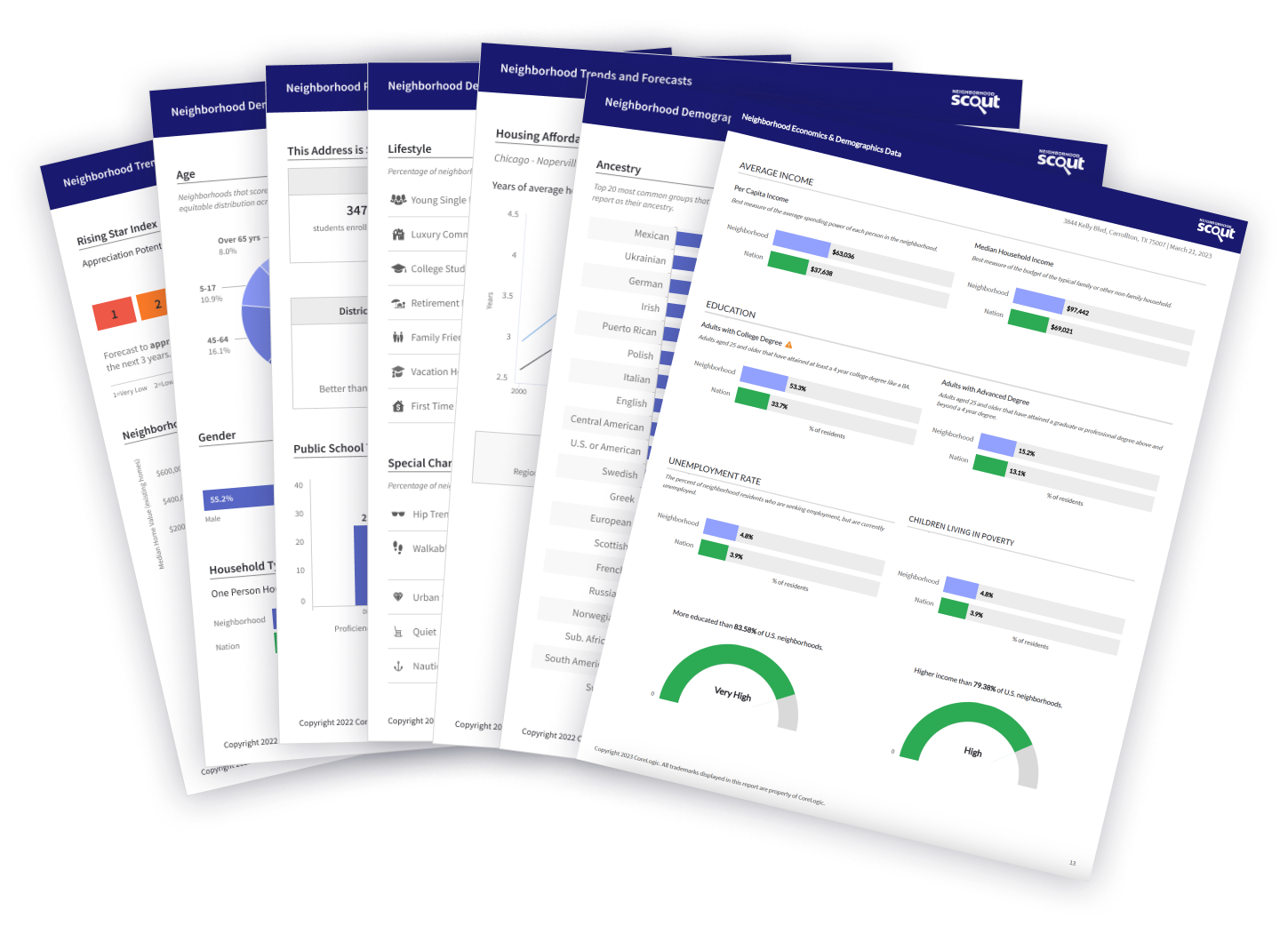
Economics & Demographics include:
Lifestyle & Special Character
Household Types
Commute To Work
Migration & Mobility
Race & Ethnic Diversity
Employment Industries & Occupations
Income & Unemployment Rate
Higher Education Attainment
Crime includes:
Neighborhood Crime Index
Crimes Per Square Mile
Property Crime Comparison
Violent Crime Comparison
Schools include:
School Ratings
Schools In District
Public School Test Scores
School District Enrollment
Educational Expenditures

comparable neighborhoods nearby