menu

Alexis, NC

This is a small community in a single neighborhood. As throughout the site, some neighborhood-level data are reserved for subscribers.


Overview


Alexis is a tiny town located in the state of North Carolina. With a population of 589 people and just one neighborhood, Alexis is the 466th largest community in North Carolina.

Occupations and Workforce

Alexis is neither predominantly blue-collar nor white-collar, instead having a mixed workforce of both blue-collar and white-collar jobs. Overall, Alexis is a town of service providers, construction workers and builders, and professionals. There are especially a lot of people living in Alexis who work in personal care services (14.79%), office and administrative support (14.08%), and teaching (10.92%).

One interesting thing about the economy is that relatively large numbers of people worked from their home: 7.75% of the workforce. While this number may seem small overall, as a fraction of the total workforce this is high compared to the rest of the county. These workers are often telecommuters who work in knowledge-based, white-collar professions. For example, Silicon Valley has large numbers of people who telecommute. Other at-home workers may be self-employed people who operate small businesses out of their homes.

Setting & Lifestyle

The town is relatively quiet, having a combination of lower population density and few of those groups of people who have a tendency to be noisy. For example, Alexis has relatively fewer families with younger children, and/or college students. Combined, this makes Alexis a pretty quiet place to live overall. If you like quiet, you will probably enjoy it here.

As is often the case in a small town, Alexis doesn't have a public transportation system that people use for their commute.

Demographics

The population of Alexis has a very low overall level of education: only 6.75% of people over 25 hold a 4-year college degree or higher.

The per capita income in Alexis in 2022 was $31,654, which is middle income relative to North Carolina, and lower middle income relative to the rest of the US. This equates to an annual income of $126,616 for a family of four. However, Alexis contains both very wealthy and poor people as well.

Alexis is a somewhat ethnically-diverse town. The people who call Alexis home describe themselves as belonging to a variety of racial and ethnic groups. The greatest number of Alexis residents report their race to be White, followed by Black or African-American. Important ancestries of people in Alexis include English, Irish, Scottish, Scandinavian, and German.

The most common language spoken in Alexis is English. Other important languages spoken here include Italian and Slavic languages.

Notable & Unique Neighborhood Characteristics

When you see a neighborhood for the first time, the most important thing is often the way it looks, like its homes and its setting. Some places look the same, but they only reveal their true character after living in them for a while because they contain a unique mix of occupational or cultural groups. This neighborhood is very unique in some important ways, according to NeighborhoodScout's exclusive exploration and analysis.

People

Astoundingly, NeighborhoodScout's research reveals that this single neighborhood has a higher concentration of married couples living here than 99.0% of all U.S. neighborhoods. Whether they have school-aged children or not, married couples are the rule in the neighborhood. If you are a married couple, you may find many people here with a similar lifestyle, and perhaps common interests. But if you are single, you might not find many other singles here.

Modes of Transportation

While most Americans do drive to work alone each day, the neighborhood stands out by having 87.3% of commuters doing so, which is a higher proportion of people driving alone to work than NeighborhoodScout found in 95.2% of all American neighborhoods.

The Neighbors

How wealthy a neighborhood is, from very wealthy, to middle income, to low income is very formative with regard to the personality and character of a neighborhood. Equally important is the rate of people, particularly children, who live below the federal poverty line. In some wealthy gated communities, the areas immediately surrounding can have high rates of childhood poverty, which indicates other social issues. NeighborhoodScout's analysis reveals both aspects of income and poverty for this neighborhood.

The neighbors in the neighborhood in Alexis are middle-income, making it a moderate income neighborhood. NeighborhoodScout's exclusive analysis reveals that this neighborhood has a higher income than 51.2% of the neighborhoods in America. In addition, 1.5% of the children seventeen and under living in this neighborhood are living below the federal poverty line, which is a lower rate of childhood poverty than is found in 76.7% of America's neighborhoods.

A neighborhood is far different if it is dominated by enlisted military personnel rather than people who earn their living by farming. It is also different if most of the neighbors are clerical support or managers. What is wonderful is the sheer diversity of neighborhoods, allowing you to find the type that fits your lifestyle and aspirations.

In the neighborhood, 31.2% of the working population is employed in manufacturing and laborer occupations. The second most important occupational group in this neighborhood is sales and service jobs, from major sales accounts, to working in fast food restaurants, with 30.1% of the residents employed. Other residents here are employed in executive, management, and professional occupations (28.8%), and 9.9% in clerical, assistant, and tech support occupations.

Languages

The most common language spoken in the neighborhood is English, spoken by 94.2% of households. Some people also speak Spanish (5.8%).

Ethnicity / Ancestry

Boston's Beacon Hill blue-blood streets, Brooklyn's Orthodox Jewish enclaves, Los Angeles' Persian neighborhoods. Each has its own culture derived primarily from the ancestries and culture of the residents who call these neighborhoods home. Likewise, each neighborhood in America has its own culture – some more unique than others – based on lifestyle, occupations, the types of households – and importantly – on the ethnicities and ancestries of the people who live in the neighborhood. Understanding where people came from, who their grandparents or great-grandparents were, can help you understand how a neighborhood is today.

In the neighborhood in Alexis, NC, residents most commonly identify their ethnicity or ancestry as English (11.2%). There are also a number of people of Irish ancestry (7.3%), and residents who report German roots (6.3%), and some of the residents are also of Mexican ancestry (4.0%), along with some Italian ancestry residents (2.3%), among others.

Getting to Work

How you get to work – car, bus, train or other means – and how much of your day it takes to do so is a large quality of life and financial issue. Especially with gasoline prices rising and expected to continue doing so, the length and means of one's commute can be a financial burden. Some neighborhoods are physically located so that many residents have to drive in their own car, others are set up so many walk to work, or can take a train, bus, or bike. The greatest number of commuters in neighborhood spend between 30 and 45 minutes commuting one-way to work (48.0% of working residents), which is at or a bit above the average length of a commute across all U.S. neighborhoods.

Here most residents (87.3%) drive alone in a private automobile to get to work. In addition, quite a number also carpool with coworkers, friends, or neighbors to get to work (5.6%) . In a neighborhood like this, as in most of the nation, many residents find owning a car useful for getting to work.


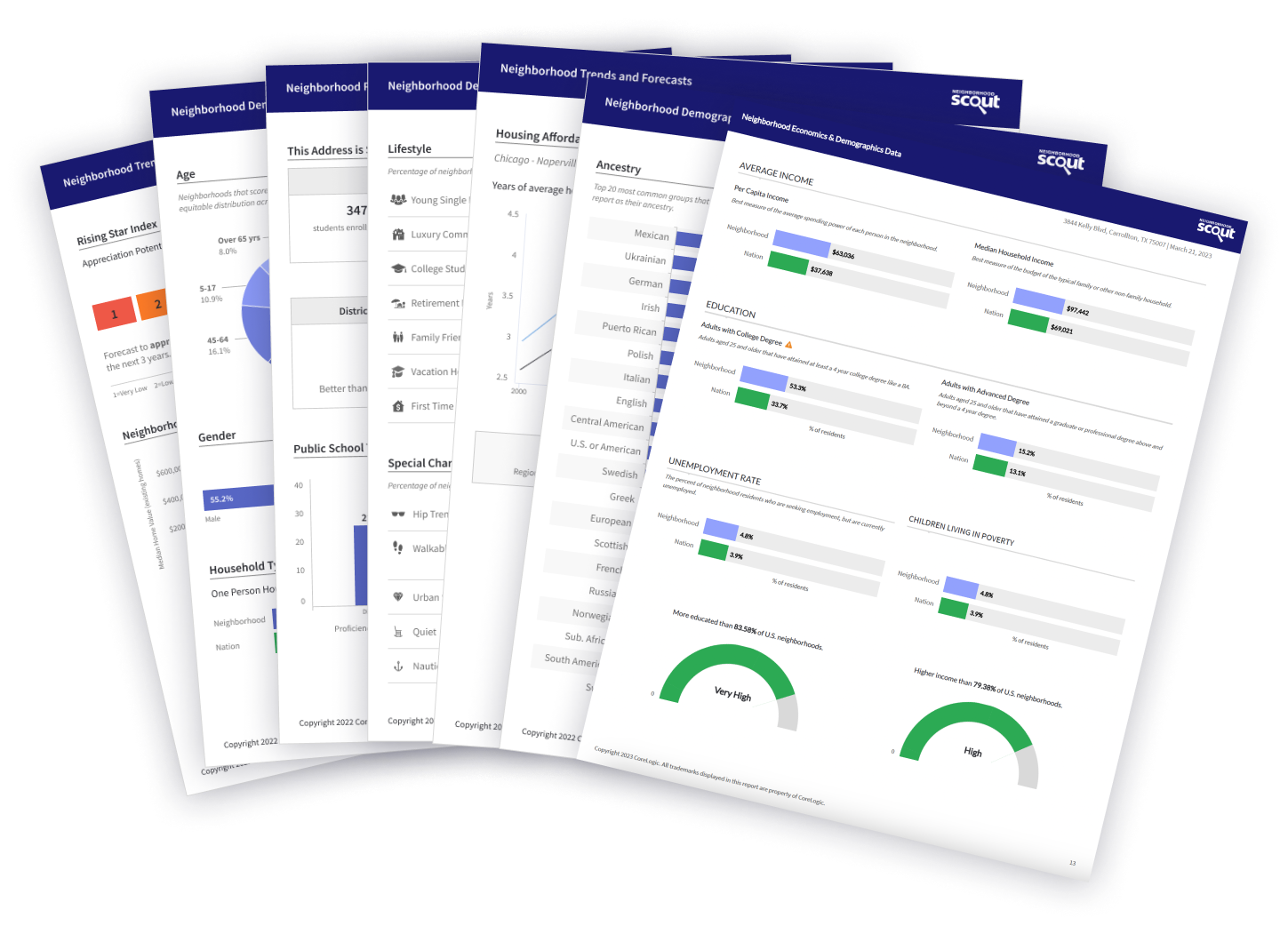
Real Estate includes:
Average Home Values
Rental Market
Housing Market Details
Neighborhood Setting
Economics & Demographics include:
Lifestyle & Special Character
Household Types
Commute To Work
Migration & Mobility
Race & Ethnic Diversity
Employment Industries & Occupations
Income & Unemployment Rate
Higher Education Attainment
Crime includes:
Neighborhood Crime Index
Crimes Per Square Mile
Property Crime Comparison
Violent Crime Comparison
Schools include:
School Ratings
Schools In District
Public School Test Scores
School District Enrollment
Educational Expenditures

comparable neighborhoods nearby