Roseland is a somewhat small borough located in the state of New Jersey. With a population of 6,370 people and just one neighborhood, Roseland is the 274th largest community in New Jersey.
Housing costs in Roseland are among some of the highest in the nation, although real estate prices here don't compare to real estate prices in the most expensive communities in New Jersey.
Roseland is a decidedly white-collar borough, with fully 91.04% of the workforce employed in white-collar jobs, well above the national average. Overall, Roseland is a borough of professionals, managers, and sales and office workers. There are especially a lot of people living in Roseland who work in management occupations (20.64%), business and financial occupations (15.10%), and teaching (10.87%).
Also of interest is that Roseland has more people living here who work in computers and math than 95% of the places in the US.
Of important note, Roseland is also a borough of artists. Roseland has more artists, designers and people working in media than 90% of the communities in America. This concentration of artists helps shape Roseland’s character.
A relatively large number of people in Roseland telecommute to their jobs. Overall, about 21.77% of the workforce works from home. While this may seem like a small number, as a fraction of the total workforce it ranks among the highest in the country. These workers are often telecommuters who work in knowledge-based, white-collar professions. For example, Silicon Valley has large numbers of people who telecommute. Other at-home workers may be self-employed people who operate small businesses out of their homes.
In addition, Roseland is home to many people who could be described as "urban sophisticates", which are people who are not only wealthy and employed in professional occupations, but highly educated to boot. Urban sophisticates have urbane tastes - whether they reside in a big or small city, a suburb, or a little town. Urban sophisticates support bookstores, quality clothing stores, enjoy luxury travel, and in big cities, they are truly the patrons of the arts, attending and supporting institutions such as opera, symphony, ballet, and theatre.
Roseland is a good choice for families with children because of several factors. Many other families with children live here, making it a place where both parents and children are more likely to develop social ties with other families. The borough’s good public school district and large population of college-educated adults provide an environment conducive to academic success. Many people own their own single-family homes, providing areas for children to play and stability in the community. Finally, Roseland’s overall crime rate is lower than average for the country.
In Roseland, however, the average commute to work is quite long. On average, people spend 32.78 minutes each day getting to work, which is significantly higher than the national average. One bright side is that local public transit is widely used, so it may be an option to avoid the headache of driving in the heavy traffic by leaving the car at home and taking transit.
In Roseland, a lot of people use the bus to get to work every day though Roseland is a relatively small borough. Those that ride the bus are primarily traveling out of town to good jobs in other cities.
If knowledge is power, Roseland is a pretty powerful place. 71.83% of the adults in Roseland have earned a 4-year college degree, masters degree, MD, law degree, or even PhD. Compare that to the national average of 21.84% for all cities and towns.
The per capita income in Roseland in 2022 was $80,904, which is wealthy relative to New Jersey and the nation. This equates to an annual income of $323,616 for a family of four.
Roseland is a very ethnically-diverse borough. The people who call Roseland home describe themselves as belonging to a variety of racial and ethnic groups. The greatest number of Roseland residents report their race to be White, followed by Asian. Important ancestries of people in Roseland include Italian, Irish, German, English, and Polish.
In addition, Roseland has a lot of people living here who were born outside of the US (16.13%).
The most common language spoken in Roseland is English. Other important languages spoken here include Chinese and Spanish.
Many things matter about a neighborhood, but the first thing most people notice is the way a neighborhood looks and its particular character. For example, one might notice whether the buildings all date from a certain time period or whether shop signs are in multiple languages. This particular neighborhood in Roseland, the neighborhood, has some outstanding things about the way it looks and its way of life that are worth highlighting.
This neighborhood has the distinction of having one of the lowest real estate vacancy rates of any neighborhood in America. With just 0.0% of the real estate vacant, this indicates an exceptionally strong demand for real estate in the neighborhood, and/or an issue with creating enough supply for the demand. This could have the effect of increasing real estate prices, increasing supply to meet demand, or both.
In addition, if you love row houses and attached homes, you will probably really like the neighborhood. The ambiance, the charm, of row houses is something special. And in sheer abundance of row houses, this neighborhood truly stands out. The real estate here has a higher proportion of row houses and attached homes than nearly any neighborhood in America. In fact, 25.0% of the residential real estate here is classified as row houses and attached homes.
In a nation where 1 out of every 4 children lives in poverty, the neighborhood stands out as being ranked among the lowest 0.0% of neighborhoods affected by this global issue.
In addition, if you're a regular supporter of the arts and enjoy outings to the theatre, weekend boutique-ing, or even a finely aged wine with dinner, than you're in good company with the people of the neighborhood. This neighborhood is uniquely immersed with more "urban sophisticates" than 97.9% of neighborhoods across the country. The people here truly stand out as a class among their own. They are an exclusive community characterized by refined tastes, cultural inclinations, and the means to live well. Urban sophisticates live a big city lifestyle, whether or not they live in or near a big city. They are educated executives or managers by week, and serial patrons of the arts by weekend. If this lifestyle pertains to you, than you'll certainly feel right at home in the neighborhood. In addition to being an excellent choice for urban sophisticates, this neighborhood is also a very good choice for active retirees.
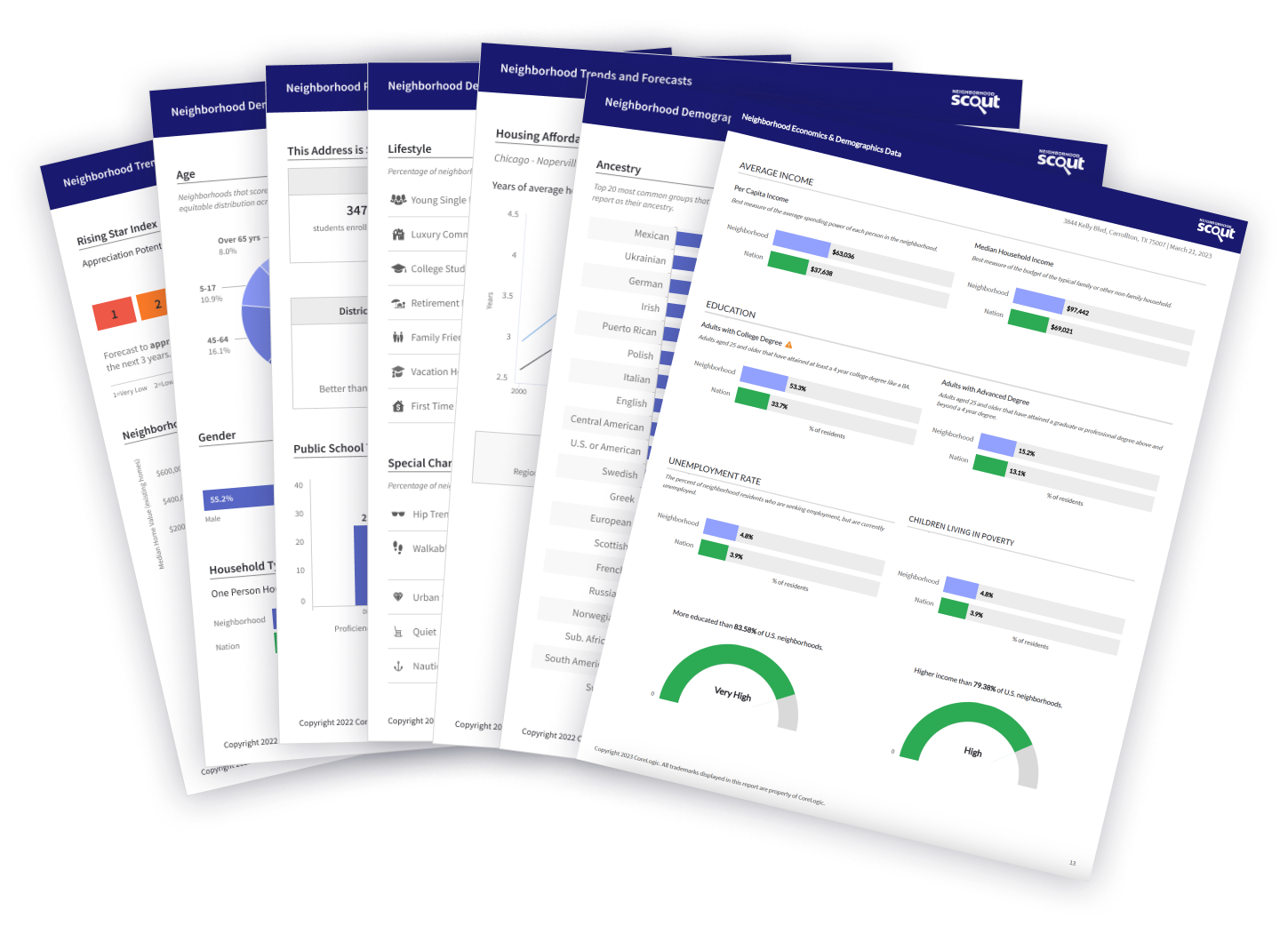
Also, if knowledge is power, then imagine the cumulative power of one neighborhood where many of the adults have earned an advanced degree, such as a Masters, law degree, medical degree, or even a Ph.D. This is certainly the case in the neighborhood, where 36.3% have earned an advanced degree. Compare that to the average neighborhood in America, where just 14.1% of adults have completed a post-graduate degree, and you can see why this neighborhood is a stand out. In fact, this neighborhood has a higher rate of adults with an advanced degree than 95.2% of the neighborhoods in America.
Executives, managers and professionals make up 76.9% of the workforce in the neighborhood which, according to NeighborhoodScout's exclusive analysis, is a higher proportion of such high-level people than is found in 98.0% of the neighborhoods in America. For this reason, this neighborhood really stands out as unique.
Did you know that the neighborhood has more Italian and Romanian ancestry people living in it than nearly any neighborhood in America? It's true! In fact, 23.4% of this neighborhood's residents have Italian ancestry and 1.1% have Romanian ancestry.
is also pretty special linguistically. Significantly, 2.1% of its residents five years old and above primarily speak German/Yiddish at home. While this may seem like a small percentage, it is higher than 96.5% of the neighborhoods in America.
There are two complementary measures for understanding the income of a neighborhood's residents: the average and the extremes. While a neighborhood may be relatively wealthy overall, it is equally important to understand the rate of people - particularly children - who are living at or below the federal poverty line, which is extremely low income. Some neighborhoods with a lower average income may actually have a lower childhood poverty rate than another with a higher average income, and this helps us understand the conditions and character of a neighborhood.
The neighbors in the neighborhood in Roseland are wealthy, making it among the 15% highest income neighborhoods in America. NeighborhoodScout's exclusive analysis reveals that this neighborhood has a higher income than 94.5% of the neighborhoods in America. In addition, 0.0% of the children seventeen and under living in this neighborhood are living below the federal poverty line, which is a lower rate of childhood poverty than is found in 100.0% of America's neighborhoods.
A neighborhood is far different if it is dominated by enlisted military personnel rather than people who earn their living by farming. It is also different if most of the neighbors are clerical support or managers. What is wonderful is the sheer diversity of neighborhoods, allowing you to find the type that fits your lifestyle and aspirations.
In the neighborhood, 76.9% of the working population is employed in executive, management, and professional occupations. The second most important occupational group in this neighborhood is manufacturing and laborer occupations, with 9.0% of the residents employed. Other residents here are employed in sales and service jobs, from major sales accounts, to working in fast food restaurants (8.9%), and 5.2% in clerical, assistant, and tech support occupations.
The languages spoken by people in this neighborhood are diverse. These are tabulated as the languages people preferentially speak when they are at home with their families. The most common language spoken in the neighborhood is English, spoken by 79.2% of households. Other important languages spoken here include Chinese, Spanish, Langs. of India and German/Yiddish.
Boston's Beacon Hill blue-blood streets, Brooklyn's Orthodox Jewish enclaves, Los Angeles' Persian neighborhoods. Each has its own culture derived primarily from the ancestries and culture of the residents who call these neighborhoods home. Likewise, each neighborhood in America has its own culture – some more unique than others – based on lifestyle, occupations, the types of households – and importantly – on the ethnicities and ancestries of the people who live in the neighborhood. Understanding where people came from, who their grandparents or great-grandparents were, can help you understand how a neighborhood is today.
In the neighborhood in Roseland, NJ, residents most commonly identify their ethnicity or ancestry as Italian (23.4%). There are also a number of people of Irish ancestry (14.2%), and residents who report Asian roots (14.1%), and some of the residents are also of German ancestry (13.1%), along with some English ancestry residents (8.7%), among others. In addition, 16.1% of the residents of this neighborhood were born in another country.
Even if your neighborhood is walkable, you may still have to drive to your place of work. Some neighborhoods are located where many can get to work in just a few minutes, while others are located such that most residents have a long and arduous commute. The greatest number of commuters in neighborhood spend between 30 and 45 minutes commuting one-way to work (30.6% of working residents), which is at or a bit above the average length of a commute across all U.S. neighborhoods.
Here most residents (66.9%) drive alone in a private automobile to get to work. In a neighborhood like this, as in most of the nation, many residents find owning a car useful for getting to work.