Windsor is a tiny town located in the state of New Jersey. With a population of 330 people and just one neighborhood, Windsor is the 510th largest community in New Jersey.
Windsor home prices are not only among the most expensive in New Jersey, but Windsor real estate also consistently ranks among the most expensive in America.
Windsor is a decidedly white-collar town, with fully 100.00% of the workforce employed in white-collar jobs, well above the national average. Overall, Windsor is a town of service providers, professionals, and sales and office workers. There are especially a lot of people living in Windsor who work in maintenance occupations (34.78%), community and social services (25.47%), and personal care services (9.94%).
Also of interest is that Windsor has more people living here who work in computers and math than 95% of the places in the US.
One interesting thing about the economy is that relatively large numbers of people worked from their home: 14.91% of the workforce. While this number may seem small overall, as a fraction of the total workforce this is high compared to the rest of the county. These workers are often telecommuters who work in knowledge-based, white-collar professions. For example, Silicon Valley has large numbers of people who telecommute. Other at-home workers may be self-employed people who operate small businesses out of their homes.
Windsor’s overall crime rate ranks among the lowest in the nation, making it a very safe place to live.
Compared to the rest of the country, citizens of Windsor spend much less time in their cars: on average, their commute to work is only 16.81 minutes. This also means that noise and pollution levels in the town are less than they would otherwise be.
Despite the fact that it is a small town, Windsor has quite a few people who take public transportation – mostly the bus - for their daily commute to work. This helps to fill a real need in the town for affordable transportation.
The population of Windsor is very well educated relative to most cities and towns in the nation, where the average community has 21.84% of its adult population holding a 4-year degree or higher: 36.27% of adults in Windsor have a bachelor's degree or even advanced degree.
The per capita income in Windsor in 2022 was $38,811, which is low income relative to New Jersey, and upper middle income relative to the rest of the US. This equates to an annual income of $155,244 for a family of four.
Windsor is an extremely ethnically-diverse town. The people who call Windsor home describe themselves as belonging to a variety of racial and ethnic groups. The greatest number of Windsor residents report their race to be White, followed by Asian. Windsor also has a sizeable Hispanic population (people of Hispanic origin can be of any race). People of Hispanic or Latino origin account for 23.62% of the town’s residents. Important ancestries of people in Windsor include German, Italian, English, Irish, and Norwegian.
Foreign born people are also an important part of Windsor's cultural character, accounting for 21.78% of the town’s population.
The most common language spoken in Windsor is English. Other important languages spoken here include Spanish and French Creole.
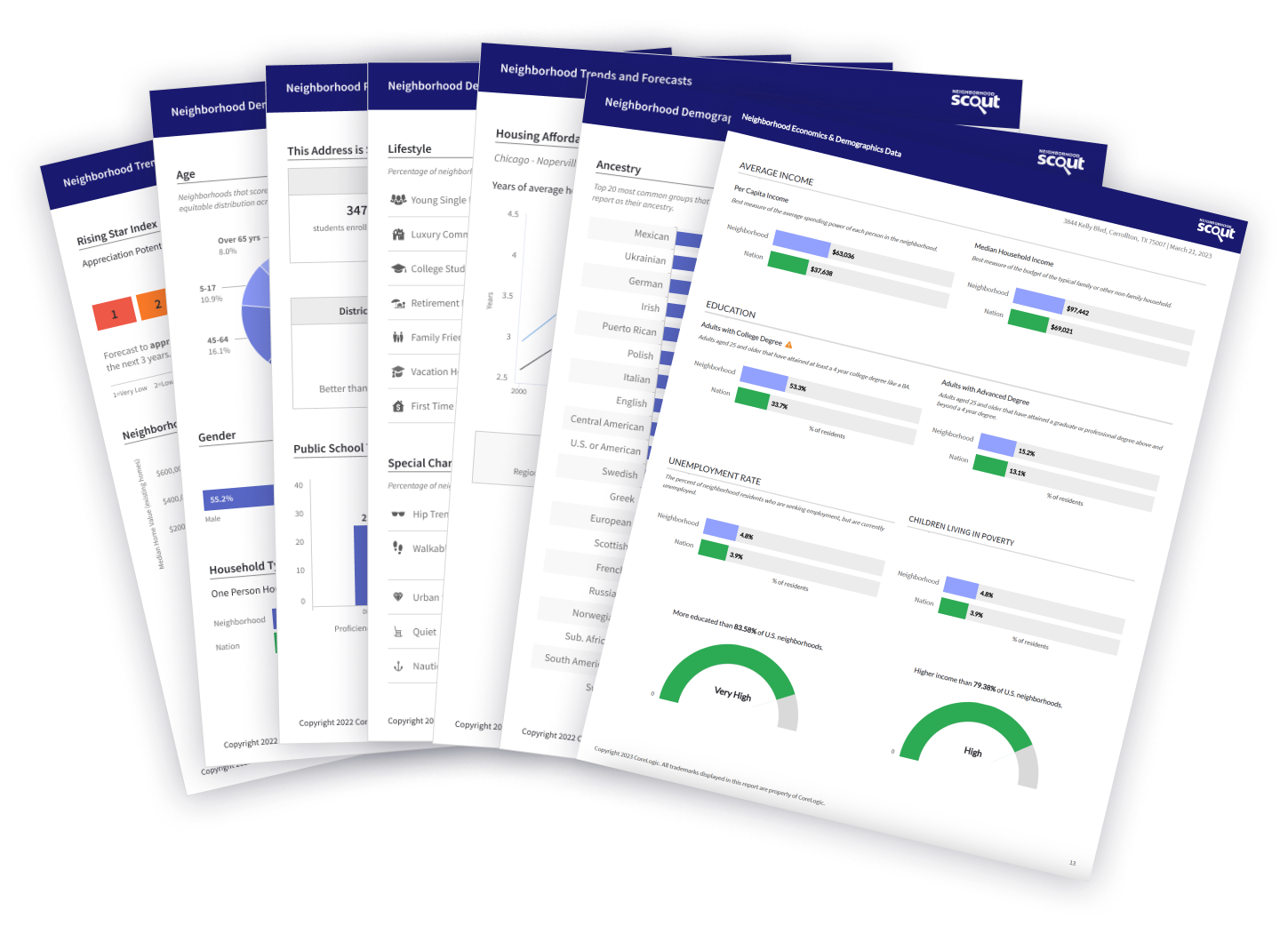
Many things matter about a neighborhood, but the first thing most people notice is the way a neighborhood looks and its particular character. For example, one might notice whether the buildings all date from a certain time period or whether shop signs are in multiple languages. This particular neighborhood in Windsor, the neighborhood, has some outstanding things about the way it looks and its way of life that are worth highlighting.
If you come to know the people here, you will recognize that you're in the company of one of the wealthiest communities in the nation. In fact, a mere 0.9% of America's neighborhoods are wealthier than the neighborhood. Real estate here is exceedingly well-maintained, and similarly, tends to maintain its value over time. The cars driven are mostly luxury brands like Mercedes, Audi, BMW, and Lexus. If the public schools aren't up to snuff, the residents of this neighborhood preferentially send their children to private preparatory schools. Vacation to Disney? Yes, but equally popular are summers in Europe. As one would expect in a considerably wealthy neighborhood such as this, also has one of the lowest ratings of child poverty in the nation.
In addition, a majority of the adults in the neighborhood are wealthy and educated executives. They own stately homes that tend to maintain high real estate appreciation rates. Their upper-level careers keep them busy, but allow them to live comfortably. If you're an executive and want to keep similar company, consider settling in this neighborhood, rated as an executive lifestyle "best choice" neighborhood for New Jersey by NeighborhoodScout's analysis, which rated it as better for executive lifestyles than 97.0% of the neighborhoods in New Jersey. In addition to being an excellent choice for highly educated executives, this neighborhood is also a very good choice for urban sophisticates and families with school-aged children.
Also, some neighborhoods have residents that are more educated than others. But in this neighborhood there is a dramatic difference. NeighborhoodScout's exclusive analysis reveals that 37.7% of the adults here have earned a Masters degree, medical degree, Ph.D. or law degree. This is a higher rate of people with a graduate degree than is found in 96.1% of U.S. neighborhoods, where the average American neighborhood has 13.7% of its adults with a graduate degree. If you are highly educated, you may have much in common with many of your neighbors here.
One way that the neighborhood really stands out, is that it has more large 4, 5, or additional bedroom homes and real estate than 98.8% of the neighborhoods in America. When you walk or drive around this neighborhood, you'll instantly notice the size of the homes here which definitely makes a strong visual statement.
A unique way of commuting is simply not to. And in the neighborhood, analysis shows that 32.3% of the residents work from home, avoiding a commute altogether. This may not seem like a large number, but it is a higher proportion of people working from home than is found in 96.2% of the neighborhoods in the United States. One thing NeighborhoodScout's research reveals is that the wealthier and/or more isolated the neighborhood, the greater the proportion of residents who choose to work from home.
Did you know that the neighborhood has more Czechoslovakian and Russian ancestry people living in it than nearly any neighborhood in America? It's true! In fact, 1.5% of this neighborhood's residents have Czechoslovakian ancestry and 4.6% have Russian ancestry.
is also pretty special linguistically. Significantly, 9.9% of its residents five years old and above primarily speak Langs. of India at home. While this may seem like a small percentage, it is higher than 99.2% of the neighborhoods in America.
The freedom of moving to new places versus the comfort of home. How much and how often people move not only can create diverse and worldly neighborhoods, but simultaneously it can produce a loss of intimacy with one's surroundings and a lack of connectedness to one's neighbors. NeighborhoodScout's exclusive research has identified this neighborhood as unique with regard to the transience of its populace. More residents of the neighborhood live here today that also were living in this same neighborhood five years ago than is found in 95.6% of U.S. neighborhoods. This neighborhood is really made up of people who know each other, don't move often, and have lived here in this very neighborhood for quite a while.
How wealthy a neighborhood is, from very wealthy, to middle income, to low income is very formative with regard to the personality and character of a neighborhood. Equally important is the rate of people, particularly children, who live below the federal poverty line. In some wealthy gated communities, the areas immediately surrounding can have high rates of childhood poverty, which indicates other social issues. NeighborhoodScout's analysis reveals both aspects of income and poverty for this neighborhood.
The neighbors in the neighborhood in Windsor are wealthy, making it among the 15% highest income neighborhoods in America. NeighborhoodScout's exclusive analysis reveals that this neighborhood has a higher income than 99.1% of the neighborhoods in America. In addition, 0.0% of the children seventeen and under living in this neighborhood are living below the federal poverty line, which is a lower rate of childhood poverty than is found in 100.0% of America's neighborhoods.
The old saying "you are what you eat" is true. But it is also true that you are what you do for a living. The types of occupations your neighbors have shape their character, and together as a group, their collective occupations shape the culture of a place.
In the neighborhood, 68.4% of the working population is employed in executive, management, and professional occupations. The second most important occupational group in this neighborhood is sales and service jobs, from major sales accounts, to working in fast food restaurants, with 17.8% of the residents employed. Other residents here are employed in clerical, assistant, and tech support occupations (10.4%), and 3.9% in government jobs, whether they are in local, state, or federal positions.
The languages spoken by people in this neighborhood are diverse. These are tabulated as the languages people preferentially speak when they are at home with their families. The most common language spoken in the neighborhood is English, spoken by 70.0% of households. Other important languages spoken here include Langs. of India and Spanish.
Boston's Beacon Hill blue-blood streets, Brooklyn's Orthodox Jewish enclaves, Los Angeles' Persian neighborhoods. Each has its own culture derived primarily from the ancestries and culture of the residents who call these neighborhoods home. Likewise, each neighborhood in America has its own culture – some more unique than others – based on lifestyle, occupations, the types of households – and importantly – on the ethnicities and ancestries of the people who live in the neighborhood. Understanding where people came from, who their grandparents or great-grandparents were, can help you understand how a neighborhood is today.
In the neighborhood in Windsor, NJ, residents most commonly identify their ethnicity or ancestry as Asian (21.9%). There are also a number of people of Irish ancestry (14.2%), and residents who report Italian roots (13.7%), and some of the residents are also of German ancestry (11.9%), along with some English ancestry residents (8.4%), among others. In addition, 25.9% of the residents of this neighborhood were born in another country.
How you get to work – car, bus, train or other means – and how much of your day it takes to do so is a large quality of life and financial issue. Especially with gasoline prices rising and expected to continue doing so, the length and means of one's commute can be a financial burden. Some neighborhoods are physically located so that many residents have to drive in their own car, others are set up so many walk to work, or can take a train, bus, or bike. The greatest number of commuters in neighborhood spend under 15 minutes commuting one-way to work (33.4% of working residents), one of the shortest commutes across America.
Here most residents (56.5%) drive alone in a private automobile to get to work. In a neighborhood like this, as in most of the nation, many residents find owning a car useful for getting to work.