menu

Kiamesha Lake, NY

This is a small community in a single neighborhood. As throughout the site, some neighborhood-level data are reserved for subscribers.


Overview

Kiamesha Lake is a tiny town located in the state of New York. With a population of 320 people and just one neighborhood, Kiamesha Lake is the 943rd largest community in New York.

Occupations and Workforce

Unlike some towns, Kiamesha Lake isn’t mainly white- or blue-collar. Instead, the most prevalent occupations for people in Kiamesha Lake are a mix of both white- and blue-collar jobs. Overall, Kiamesha Lake is a town of sales and office workers, service providers, and transportation and shipping workers. There are especially a lot of people living in Kiamesha Lake who work in office and administrative support (47.80%), personal care services (18.05%), and maintenance occupations (7.80%).

Setting & Lifestyle

It is a fairly quiet town because there are relatively few of those groups of people who have a tendency to be noisy. (Children, for example, often can't help themselves from being noisy, and being parents ourselves, we know!) Kiamesha Lake has relatively few families with children living at home, and is quieter because of it. Renters and college students, for their own reasons, can also be noisy. Kiamesha Lake has few renters and college students. But the biggest reason it is quieter in Kiamesha Lake than in most places in America, is that there are just simply fewer people living here. If you think trees make good neighbors, Kiamesha Lake may be for you.

Kiamesha Lake is a small town, and as is often the case with smaller towns, the population isn't large or dense enough to support much in the way of a public transportation system. In fact, there are many rural roads around Kiamesha Lake, which makes walking or biking to and from work a bit difficult. This makes for a very car-oriented town: 100.00% of residents commute to work by private automobile, and people often drive out of town for work, shopping, and other activities.

Being a small town, Kiamesha Lake does not have a public transit system used by locals to get to and from work.

Demographics

In Kiamesha Lake, just 11.96% of people have at least a bachelor's degree, which is quite a bit lower than the national average for cities and towns of 21.84%.

The per capita income in Kiamesha Lake in 2022 was $39,618, which is middle income relative to New York, and upper middle income relative to the rest of the US. This equates to an annual income of $158,472 for a family of four. However, Kiamesha Lake contains both very wealthy and poor people as well.

Kiamesha Lake is an extremely ethnically-diverse town. The people who call Kiamesha Lake home describe themselves as belonging to a variety of racial and ethnic groups. The greatest number of Kiamesha Lake residents report their race to be White, followed by Black or African-American. Important ancestries of people in Kiamesha Lake include Italian, English, Dutch, Yugoslavian, and Other West Indian.

The most common language spoken in Kiamesha Lake is English. Other important languages spoken here include Polish and Langs. of India.

Notable & Unique Neighborhood Characteristics

The way a neighborhood looks and feels when you walk or drive around it, from its setting, its buildings, and its flavor, can make all the difference. This neighborhood has some really cool things about the way it looks and feels as revealed by NeighborhoodScout's exclusive research. This might include anything from the housing stock to the types of households living here to how people get around.

Real Estate

If you love row houses and attached homes, you will probably really like the neighborhood. The ambiance, the charm, of row houses is something special. And in sheer abundance of row houses, this neighborhood truly stands out. The real estate here has a higher proportion of row houses and attached homes than nearly any neighborhood in America. In fact, 32.6% of the residential real estate here is classified as row houses and attached homes.

In addition, vacant homes and apartments are a significant characteristic of this neighborhood. In fact, with 33.0% of the residential real estate vacant, the neighborhood claims the distinction of having a higher vacancy rate than 96.2% of the neighborhoods in America. This can either be because much of the property is seasonally occupied, like in many vacation areas, or that much of the real estate is more permanently abandoned.

Modes of Transportation

Would you like to be able to ride your bike to work? If you are attracted to the idea of getting a little exercise of the two-wheeled type while reducing your carbon footprint, bicycling to work might be the answer. But which neighborhood you live in can make this either impossible, or alternatively, a great and realistic option. NeighborhoodScout's analysis revealed that the neighborhood is a fantastic option for bicycle commuters, as 3.8% of commuters here do ride their bikes to and from work on a daily basis. This is a higher amount than we found in 97.1% of the neighborhoods in America.

People

Of note, 59.3% of the children in this area live in poverty; an extraordinarily high percentage compared to other neighborhoods in the nation. In a nation where approximately one in four children grows up in poverty, this neighborhood stands out for the depth of the problem manifested here.

In addition, there is an especially high percentage of incarcerated people (1.4%) living in the neighborhood.

Also, is ranked among the top 7.6% of neighborhoods for first-time home buyers to consider in the state of New York according to NeighborhoodScout's exclusive analysis. Homes here are priced below median housing values in the state, yet maintain moderate appreciation rates compared to other communities. Buying into the neighborhood is not only an accessible option but an investment opportunity for many first-time home buyers. In addition to being an excellent choice for first-time home buyers, this neighborhood is also a very good choice for active retirees.

Diversity

Did you know that the neighborhood has more Austrian and Hungarian ancestry people living in it than nearly any neighborhood in America? It's true! In fact, 3.6% of this neighborhood's residents have Austrian ancestry and 5.1% have Hungarian ancestry.

is also pretty special linguistically. Significantly, 16.2% of its residents five years old and above primarily speak German/Yiddish at home. While this may seem like a small percentage, it is higher than 99.7% of the neighborhoods in America.

The Neighbors

There are two complementary measures for understanding the income of a neighborhood's residents: the average and the extremes. While a neighborhood may be relatively wealthy overall, it is equally important to understand the rate of people - particularly children - who are living at or below the federal poverty line, which is extremely low income. Some neighborhoods with a lower average income may actually have a lower childhood poverty rate than another with a higher average income, and this helps us understand the conditions and character of a neighborhood.

The neighbors in the neighborhood in Kiamesha Lake are lower-middle income, making it a below average income neighborhood. NeighborhoodScout's research shows that this neighborhood has an income lower than 78.2% of U.S. neighborhoods. With 59.3% of the children here below the federal poverty line, this neighborhood has a higher rate of childhood poverty than 96.8% of U.S. neighborhoods.

A neighborhood is far different if it is dominated by enlisted military personnel rather than people who earn their living by farming. It is also different if most of the neighbors are clerical support or managers. What is wonderful is the sheer diversity of neighborhoods, allowing you to find the type that fits your lifestyle and aspirations.

In the neighborhood, 33.7% of the working population is employed in executive, management, and professional occupations. The second most important occupational group in this neighborhood is sales and service jobs, from major sales accounts, to working in fast food restaurants, with 28.3% of the residents employed. Other residents here are employed in manufacturing and laborer occupations (22.6%), and 15.3% in clerical, assistant, and tech support occupations.

Languages

The languages spoken by people in this neighborhood are diverse. These are tabulated as the languages people preferentially speak when they are at home with their families. The most common language spoken in the neighborhood is English, spoken by 65.2% of households. Other important languages spoken here include German/Yiddish, Spanish and Russian.

Ethnicity / Ancestry

Culture is the shared learned behavior of peoples. Undeniably, different ethnicities and ancestries have different cultural traditions, and as a result, neighborhoods with concentrations of residents of one or another ethnicities or ancestries will express those cultures. It is what makes the North End in Boston so fun to visit for the Italian restaurants, bakeries, culture, and charm, and similarly, why people enjoy visiting Chinatown in San Francisco.

In the neighborhood in Kiamesha Lake, NY, residents most commonly identify their ethnicity or ancestry as Italian (11.7%). There are also a number of people of Puerto Rican ancestry (10.6%), and residents who report English roots (10.5%), and some of the residents are also of Irish ancestry (10.5%), along with some German ancestry residents (6.5%), among others. In addition, 10.0% of the residents of this neighborhood were born in another country.

Getting to Work

How you get to work – car, bus, train or other means – and how much of your day it takes to do so is a large quality of life and financial issue. Especially with gasoline prices rising and expected to continue doing so, the length and means of one's commute can be a financial burden. Some neighborhoods are physically located so that many residents have to drive in their own car, others are set up so many walk to work, or can take a train, bus, or bike. The greatest number of commuters in neighborhood spend under 15 minutes commuting one-way to work (52.4% of working residents), one of the shortest commutes across America.

Here most residents (72.7%) drive alone in a private automobile to get to work. In addition, quite a number also carpool with coworkers, friends, or neighbors to get to work (11.6%) and 7.1% of residents also hop out the door and walk to work for their daily commute. In a neighborhood like this, as in most of the nation, many residents find owning a car useful for getting to work.

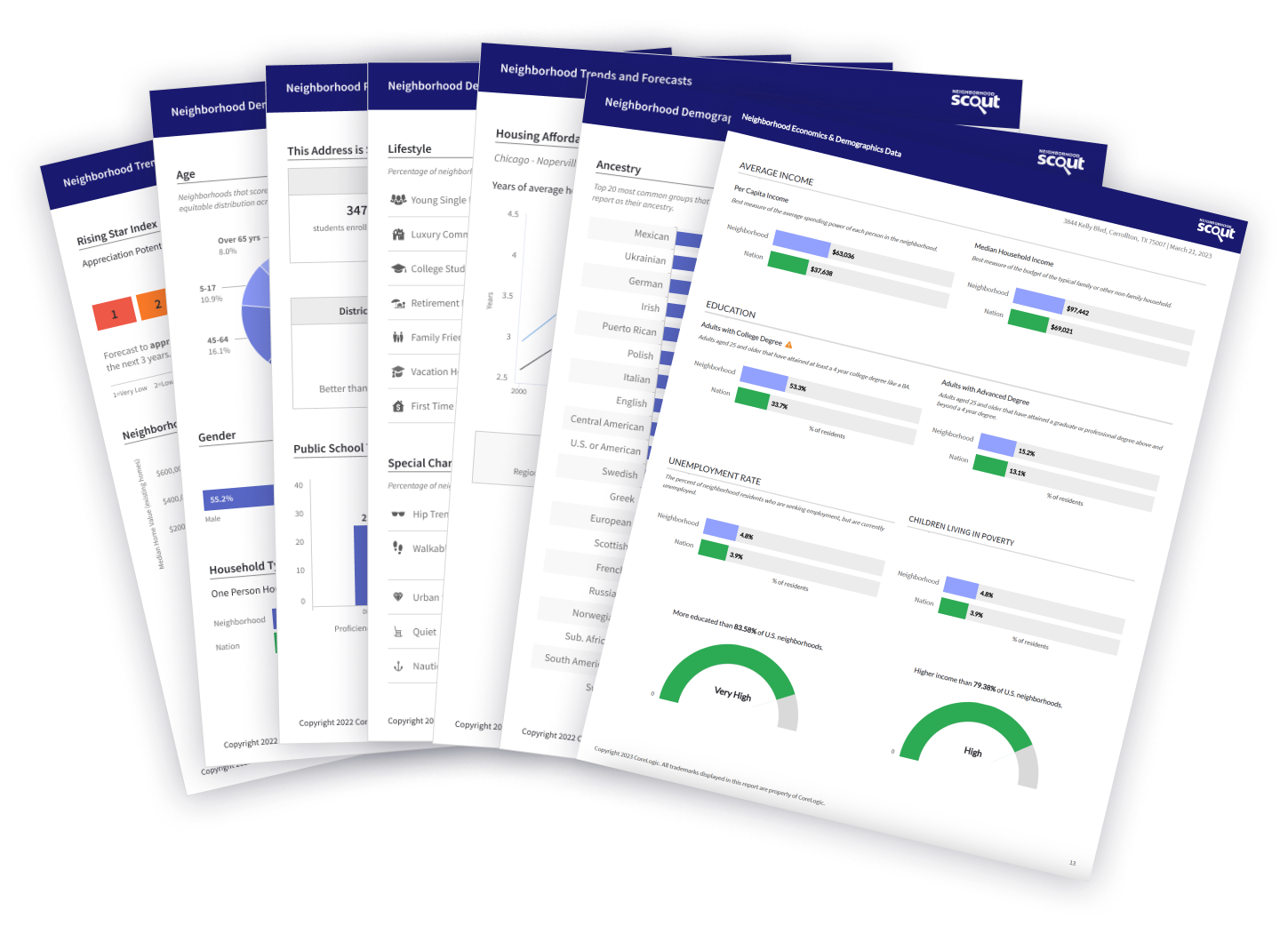
Real Estate includes:
Average Home Values
Rental Market
Housing Market Details
Neighborhood Setting
Economics & Demographics include:
Lifestyle & Special Character
Household Types
Commute To Work
Migration & Mobility
Race & Ethnic Diversity
Employment Industries & Occupations
Income & Unemployment Rate
Higher Education Attainment
Crime includes:
Neighborhood Crime Index
Crimes Per Square Mile
Property Crime Comparison
Violent Crime Comparison
Schools include:
School Ratings
Schools In District
Public School Test Scores
School District Enrollment
Educational Expenditures

comparable neighborhoods nearby