menu


Real Estate Prices & Overview

38th Ave / 104th St median real estate price is $502,077, which is more expensive than 38.7% of the neighborhoods in New York and 65.2% of the neighborhoods in the U.S.

The average rental price in 38th Ave / 104th St is currently $4,068, based on NeighborhoodScout's exclusive analysis. The average rental cost in this neighborhood is higher than 74.4% of the neighborhoods in New York.

38th Ave / 104th St is a densely urban neighborhood (based on population density) located in Queens, New York.

38th Ave / 104th St real estate is primarily made up of small (studio to two bedroom) to medium sized (three or four bedroom) apartment complexes/high-rise apartments and small apartment buildings. Most of the residential real estate is renter occupied. Many of the residences in the 38th Ave / 104th St neighborhood are newer, built in 2000 or more recently. A number of residences were also built between 1940 and 1969.

In 38th Ave / 104th St, the current vacancy rate is 2.3%, which is a lower rate of vacancies than 83.4% of all neighborhoods in the U.S. This means that the housing supply in 38th Ave / 104th St is very tight compared to the demand for property here.

Notable & Unique Neighborhood Characteristics

When you see a neighborhood for the first time, the most important thing is often the way it looks, like its homes and its setting. Some places look the same, but they only reveal their true character after living in them for a while because they contain a unique mix of occupational or cultural groups. This neighborhood is very unique in some important ways, according to NeighborhoodScout's exclusive exploration and analysis.

Modes of Transportation

In the 38th Ave / 104th St neighborhood, 59.1% of people ride the train to work each day. This is a very high percentage compared to most places. In fact, NeighborhoodScout's analysis reveals that this is a higher level of train ridership than in 99.9% of the neighborhoods in America.

Real Estate

What you'll find when you visit or move to this neighborhood is one of the most crowded neighborhoods in all of America. With an incredible 110,740 people per square mile, it is more densely populated than 99.8% of America's neighborhoods.

In addition, three-deckers, duplexes, old Victorian homes cut up into apartments. Independent stores on the corner selling pizza. These are some of the hallmarks of neighborhoods with lots of small 2, 3, and 4 unit apartment buildings. The 38th Ave / 104th St neighborhood really stands out in this regard, however, as it is dominated by such small apartment buildings more than nearly any other neighborhood in America. This is a stunning visual and lifestyle example of this type of neighborhood. In fact, 37.7% of the real estate here are small 2, 3, or 4 unit apartment buildings, which is a higher proportion than found in 96.7% of America's neighborhoods.

Car Ownership

We Americans love our cars. Not only are they a necessity for most Americans due to the shape of our neighborhoods and the distances between where we live, work, shop, and go to school, but we also fancy them. As a result, most households in America have one, two, or three cars. But NeighborhoodScout's exclusive analysis shows that the 38th Ave / 104th St neighborhood has a highly unusual pattern of car ownership. 59.2% of the households in this neighborhood don't own a car at all. This is more carless households than NeighborhoodScout found in 99.2% of U.S. neighborhoods.

Occupations

NeighborhoodScout's exclusive research identifies the 38th Ave / 104th St neighborhood as having one of the highest concentrations of people employed in manufacturing or as laborers of any neighborhood in America. In fact, despite the loss of manufacturing jobs nationally, this neighborhood has 44.9% of its working residents employed in such fields, which is a higher proportion than 97.3% of American neighborhoods.

People

NeighborhoodScout's exclusive research revealed that 93.8% of the adult residents in the 38th Ave / 104th St neighborhood do not have a 4-year college degree, which is a lower rate of college graduated adults than found in 96.4% of the neighborhoods in America.

Diversity

Did you know that the 38th Ave / 104th St neighborhood has more South American and Dominican ancestry people living in it than nearly any neighborhood in America? It's true! In fact, 38.8% of this neighborhood's residents have South American ancestry and 14.6% have Dominican ancestry.

38th Ave / 104th St is also pretty special linguistically. Significantly, 81.8% of its residents five years old and above primarily speak Spanish at home. This is a higher percentage than 98.9% of all U.S. neighborhoods.

Migration / Stability

Some neighborhoods have more internal cohesiveness than others. While other neighborhoods feel like a collection of strangers who just happen to live near each other. Sometimes this comes down to not only the personalities of the people in a place, but how long people have been together in that neighborhood. NeighborhoodScout's research has revealed some interesting things about the rootedness of people in the 38th Ave / 104th St neighborhood. What is interesting to note, is that the 38th Ave / 104th St neighborhood has a greater percentage of residents born in another country (64.9%) than are found in 99.5% of all U.S. neighborhoods.

The Neighbors

How wealthy a neighborhood is, from very wealthy, to middle income, to low income is very formative with regard to the personality and character of a neighborhood. Equally important is the rate of people, particularly children, who live below the federal poverty line. In some wealthy gated communities, the areas immediately surrounding can have high rates of childhood poverty, which indicates other social issues. NeighborhoodScout's analysis reveals both aspects of income and poverty for this neighborhood.

The neighbors in the 38th Ave / 104th St neighborhood in Queens are middle-income, making it a moderate income neighborhood. NeighborhoodScout's exclusive analysis reveals that this neighborhood has a higher income than 54.5% of the neighborhoods in America. With 31.3% of the children here below the federal poverty line, this neighborhood has a higher rate of childhood poverty than 83.1% of U.S. neighborhoods.

A neighborhood is far different if it is dominated by enlisted military personnel rather than people who earn their living by farming. It is also different if most of the neighbors are clerical support or managers. What is wonderful is the sheer diversity of neighborhoods, allowing you to find the type that fits your lifestyle and aspirations.

In the 38th Ave / 104th St neighborhood, 44.9% of the working population is employed in manufacturing and laborer occupations. The second most important occupational group in this neighborhood is sales and service jobs, from major sales accounts, to working in fast food restaurants, with 33.7% of the residents employed. Other residents here are employed in executive, management, and professional occupations (13.6%), and 7.8% in clerical, assistant, and tech support occupations.

Languages

The languages spoken by people in this neighborhood are diverse. These are tabulated as the languages people preferentially speak when they are at home with their families. The most common language spoken in the 38th Ave / 104th St neighborhood is Spanish, spoken by 81.8% of households. Other important languages spoken here include Chinese and English.

Ethnicity / Ancestry

Boston's Beacon Hill blue-blood streets, Brooklyn's Orthodox Jewish enclaves, Los Angeles' Persian neighborhoods. Each has its own culture derived primarily from the ancestries and culture of the residents who call these neighborhoods home. Likewise, each neighborhood in America has its own culture – some more unique than others – based on lifestyle, occupations, the types of households – and importantly – on the ethnicities and ancestries of the people who live in the neighborhood. Understanding where people came from, who their grandparents or great-grandparents were, can help you understand how a neighborhood is today.

In the 38th Ave / 104th St neighborhood in Queens, NY, residents most commonly identify their ethnicity or ancestry as South American (38.8%). There are also a number of people of Mexican ancestry (23.0%), and residents who report Dominican roots (14.6%), and some of the residents are also of Asian ancestry (11.0%), along with some Norwegian ancestry residents (1.3%), among others. In addition, 64.9% of the residents of this neighborhood were born in another country.

Getting to Work

How you get to work – car, bus, train or other means – and how much of your day it takes to do so is a large quality of life and financial issue. Especially with gasoline prices rising and expected to continue doing so, the length and means of one's commute can be a financial burden. Some neighborhoods are physically located so that many residents have to drive in their own car, others are set up so many walk to work, or can take a train, bus, or bike. The greatest number of commuters in 38th Ave / 104th St neighborhood spend between 45 minutes and one hour commuting one-way to work (65.9% of working residents), longer and tougher than most commutes in America.

Here most residents (59.1%) take the train to get to work. In addition, quite a number also drive alone in a private automobile to get to work (12.3%) and 11.6% of residents also carpool with coworkers, friends, or neighbors for their daily commute. This neighborhood is distinguished by the high number of residents who take the train to work each day, which can be a very good way to get to work at a lower cost and with less pollution.

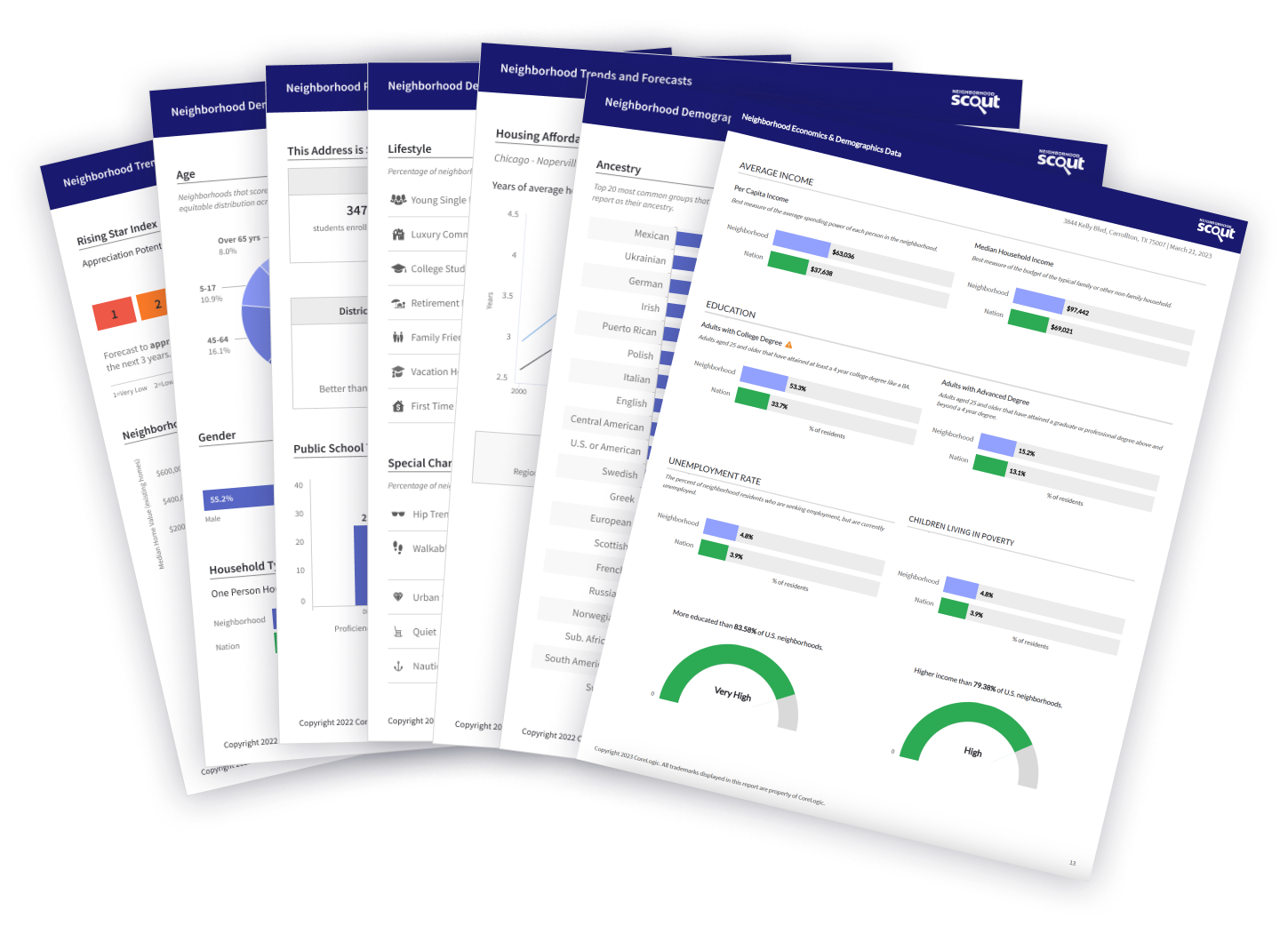
Real Estate includes:
Average Home Values
Rental Market
Housing Market Details
Neighborhood Setting
Economics & Demographics include:
Lifestyle & Special Character
Household Types
Commute To Work
Migration & Mobility
Race & Ethnic Diversity
Employment Industries & Occupations
Income & Unemployment Rate
Higher Education Attainment
Crime includes:
Neighborhood Crime Index
Crimes Per Square Mile
Property Crime Comparison
Violent Crime Comparison
Schools include:
School Ratings
Schools In District
Public School Test Scores
School District Enrollment
Educational Expenditures

comparable neighborhoods nearby