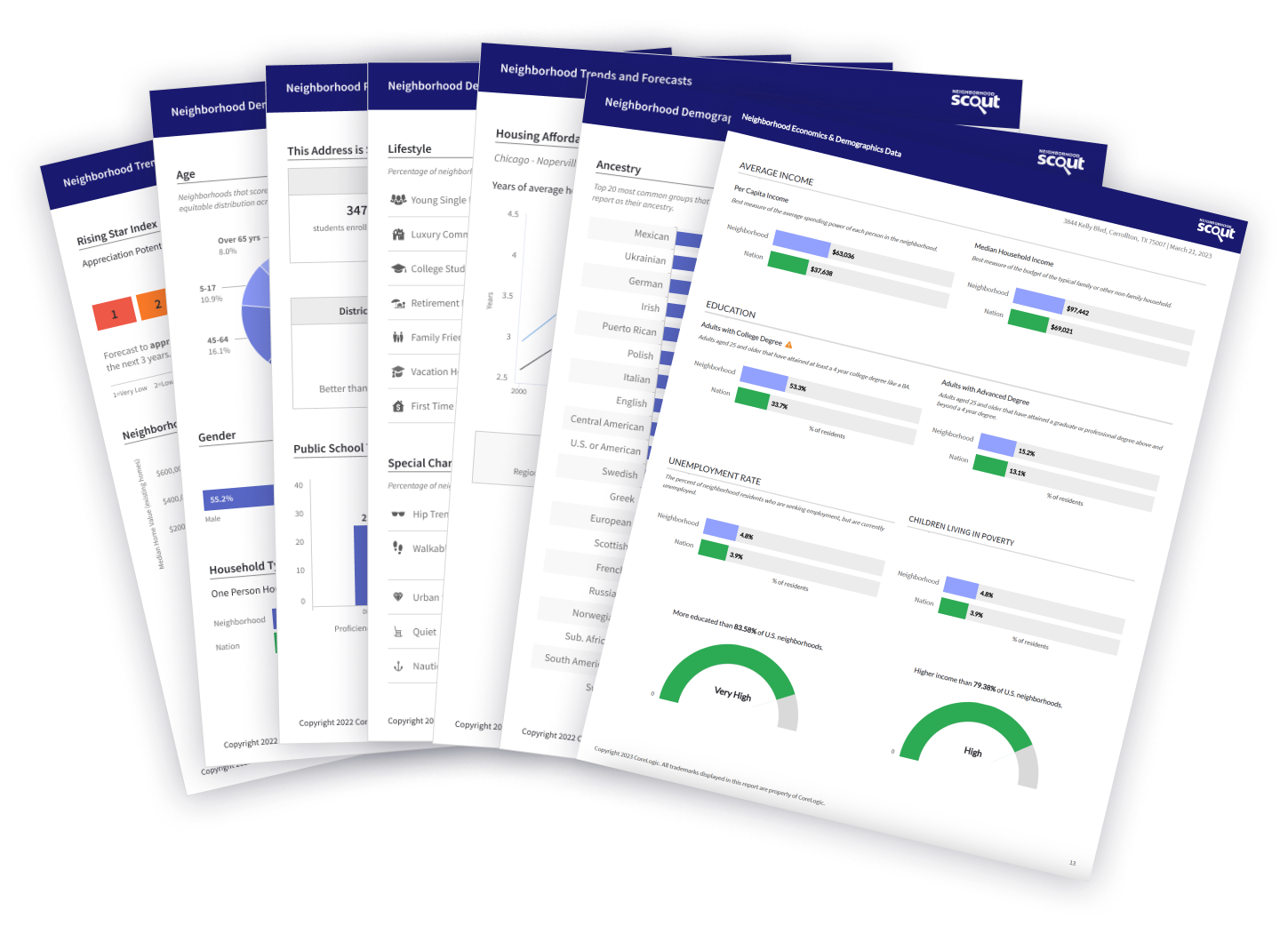
Montrose Ghent / Bath median real estate price is $948,316, which is more expensive than 99.2% of the neighborhoods in Ohio and 88.2% of the neighborhoods in the U.S.
The average rental price in Montrose Ghent / Bath is currently $3,428, based on NeighborhoodScout's exclusive analysis. The average rental cost in this neighborhood is higher than 99.0% of the neighborhoods in Ohio.
Montrose Ghent / Bath is a rural neighborhood (based on population density) located in Akron, Ohio.
Montrose Ghent / Bath real estate is primarily made up of medium sized (three or four bedroom) to large (four, five or more bedroom) single-family homes and small apartment buildings. Most of the residential real estate is owner occupied. Many of the residences in the Montrose Ghent / Bath neighborhood are established but not old, having been built between 1970 and 1999. A number of residences were also built between 1940 and 1969.
Home and apartment vacancy rates are 7.5% in Montrose Ghent / Bath. NeighborhoodScout analysis shows that this rate is lower than 48.3% of the neighborhoods in the nation, approximately near the middle range for vacancies.
When you see a neighborhood for the first time, the most important thing is often the way it looks, like its homes and its setting. Some places look the same, but they only reveal their true character after living in them for a while because they contain a unique mix of occupational or cultural groups. This neighborhood is very unique in some important ways, according to NeighborhoodScout's exclusive exploration and analysis.
Astoundingly, NeighborhoodScout's research reveals that this single neighborhood has a higher concentration of married couples living here than 98.9% of all U.S. neighborhoods. Whether they have school-aged children or not, married couples are the rule in the Montrose Ghent / Bath neighborhood. If you are a married couple, you may find many people here with a similar lifestyle, and perhaps common interests. But if you are single, you might not find many other singles here.
In addition, a majority of the adults in the Montrose Ghent / Bath neighborhood are wealthy and educated executives. They own stately homes that tend to maintain high real estate appreciation rates. Their upper-level careers keep them busy, but allow them to live comfortably. If you're an executive and want to keep similar company, consider settling in this neighborhood, rated as an executive lifestyle "best choice" neighborhood for Ohio by NeighborhoodScout's analysis, which rated it as better for executive lifestyles than 98.6% of the neighborhoods in Ohio. In addition to being an excellent choice for highly educated executives, this neighborhood is also a very good choice for urban sophisticates and families with school-aged children.
Also, do you like to read, write, and learn? Are you curious about the world? If so, this neighborhood may be a good fit for you. NeighborhoodScout's research revealed that a full 77.4% of the adults living in the Montrose Ghent / Bath neighborhood have earned at least a bachelor's degree. This is a higher rate than NeighborhoodScout found in 96.7% of U.S. neighborhoods. In this way, this neighborhood truly stands out.
Finally, if you come to know the people here, you will recognize that you're in the company of one of the wealthiest communities in the nation. In fact, a mere 3.5% of America's neighborhoods are wealthier than the Montrose Ghent / Bath neighborhood. Real estate here is exceedingly well-maintained, and similarly, tends to maintain its value over time. The cars driven are mostly luxury brands like Mercedes, Audi, BMW, and Lexus. If the public schools aren't up to snuff, the residents of this neighborhood preferentially send their children to private preparatory schools. Vacation to Disney? Yes, but equally popular are summers in Europe.
One way that the Montrose Ghent / Bath neighborhood really stands out, is that it has more large 4, 5, or additional bedroom homes and real estate than 98.9% of the neighborhoods in America. When you walk or drive around this neighborhood, you'll instantly notice the size of the homes here which definitely makes a strong visual statement.
In addition, the Montrose Ghent / Bath neighborhood has earned the amazing distinction of having one of the highest rates of detached, single-family homes of any neighborhood in the U.S. With 98.7% of the residential real estate here made up of free-standing single-family homes, there is a greater proportion of single-family homes here than in 97.3% of all neighborhoods in America.
Furthermore, real estate in the Montrose Ghent / Bath neighborhood is almost exclusively owner-occupied. NeighborhoodScout's analysis reveals that this neighborhood has a higher rate of owner-occupied housing than is found in 96.4% of U.S. neighborhoods. If you are seeking to rent, this neighborhood may not have many options, but high rates of ownership often indicate stability in a neighborhood.
Regardless of the means by which residents commute, this neighborhood has a length of commute that is notable. Long commutes can be brutal. They take time, money, and energy, leaving less of you for yourself and your family. The residents of the Montrose Ghent / Bath neighborhood unfortunately have the distinction of having, on average, a longer commute than most any neighborhood in America. 11.5% of commuters here travel more than one hour just one-way to work. That is more than two hours per day. This percentage with two-hour + round-trip commutes is higher than NeighborhoodScout found in 97.0% of all neighborhoods in America.
Did you know that the Montrose Ghent / Bath neighborhood has more Croatian and Hungarian ancestry people living in it than nearly any neighborhood in America? It's true! In fact, 2.9% of this neighborhood's residents have Croatian ancestry and 2.8% have Hungarian ancestry.
The freedom of moving to new places versus the comfort of home. How much and how often people move not only can create diverse and worldly neighborhoods, but simultaneously it can produce a loss of intimacy with one's surroundings and a lack of connectedness to one's neighbors. NeighborhoodScout's exclusive research has identified this neighborhood as unique with regard to the transience of its populace. More residents of the Montrose Ghent / Bath neighborhood live here today that also were living in this same neighborhood five years ago than is found in 95.4% of U.S. neighborhoods. This neighborhood is really made up of people who know each other, don't move often, and have lived here in this very neighborhood for quite a while.
There are two complementary measures for understanding the income of a neighborhood's residents: the average and the extremes. While a neighborhood may be relatively wealthy overall, it is equally important to understand the rate of people - particularly children - who are living at or below the federal poverty line, which is extremely low income. Some neighborhoods with a lower average income may actually have a lower childhood poverty rate than another with a higher average income, and this helps us understand the conditions and character of a neighborhood.
The neighbors in the Montrose Ghent / Bath neighborhood in Akron are wealthy, making it among the 15% highest income neighborhoods in America. NeighborhoodScout's exclusive analysis reveals that this neighborhood has a higher income than 96.5% of the neighborhoods in America. In addition, 6.9% of the children seventeen and under living in this neighborhood are living below the federal poverty line, which is a lower rate of childhood poverty than is found in 57.9% of America's neighborhoods.
The old saying "you are what you eat" is true. But it is also true that you are what you do for a living. The types of occupations your neighbors have shape their character, and together as a group, their collective occupations shape the culture of a place.
In the Montrose Ghent / Bath neighborhood, 67.6% of the working population is employed in executive, management, and professional occupations. The second most important occupational group in this neighborhood is sales and service jobs, from major sales accounts, to working in fast food restaurants, with 19.0% of the residents employed. Other residents here are employed in manufacturing and laborer occupations (8.6%), and 4.7% in clerical, assistant, and tech support occupations.
Languages
The most common language spoken in the Montrose Ghent / Bath neighborhood is English, spoken by 95.8% of households.
Ethnicity / Ancestry
Culture is shared learned behavior. We learn it from our parents, their parents, our houses of worship, and much of our culture – our learned behavior – comes from our ancestors. That is why ancestry and ethnicity can be so interesting and important to understand: places with concentrations of people of one or more ancestries often express those shared learned behaviors and this gives each neighborhood its own culture. Even different neighborhoods in the same city can have drastically different cultures.
In the Montrose Ghent / Bath neighborhood in Akron, OH, residents most commonly identify their ethnicity or ancestry as German (39.4%). There are also a number of people of Irish ancestry (24.0%), and residents who report English roots (22.4%), and some of the residents are also of Italian ancestry (6.3%), along with some Polish ancestry residents (3.6%), among others.
Even if your neighborhood is walkable, you may still have to drive to your place of work. Some neighborhoods are located where many can get to work in just a few minutes, while others are located such that most residents have a long and arduous commute. The greatest number of commuters in Montrose Ghent / Bath neighborhood spend between 15 and 30 minutes commuting one-way to work (34.4% of working residents), which is shorter than the time spent commuting to work for most Americans. However, there is also a significant group of residents (11.5%) who commute over an hour in each direction.
Here most residents (68.6%) drive alone in a private automobile to get to work. In a neighborhood like this, as in most of the nation, many residents find owning a car useful for getting to work.