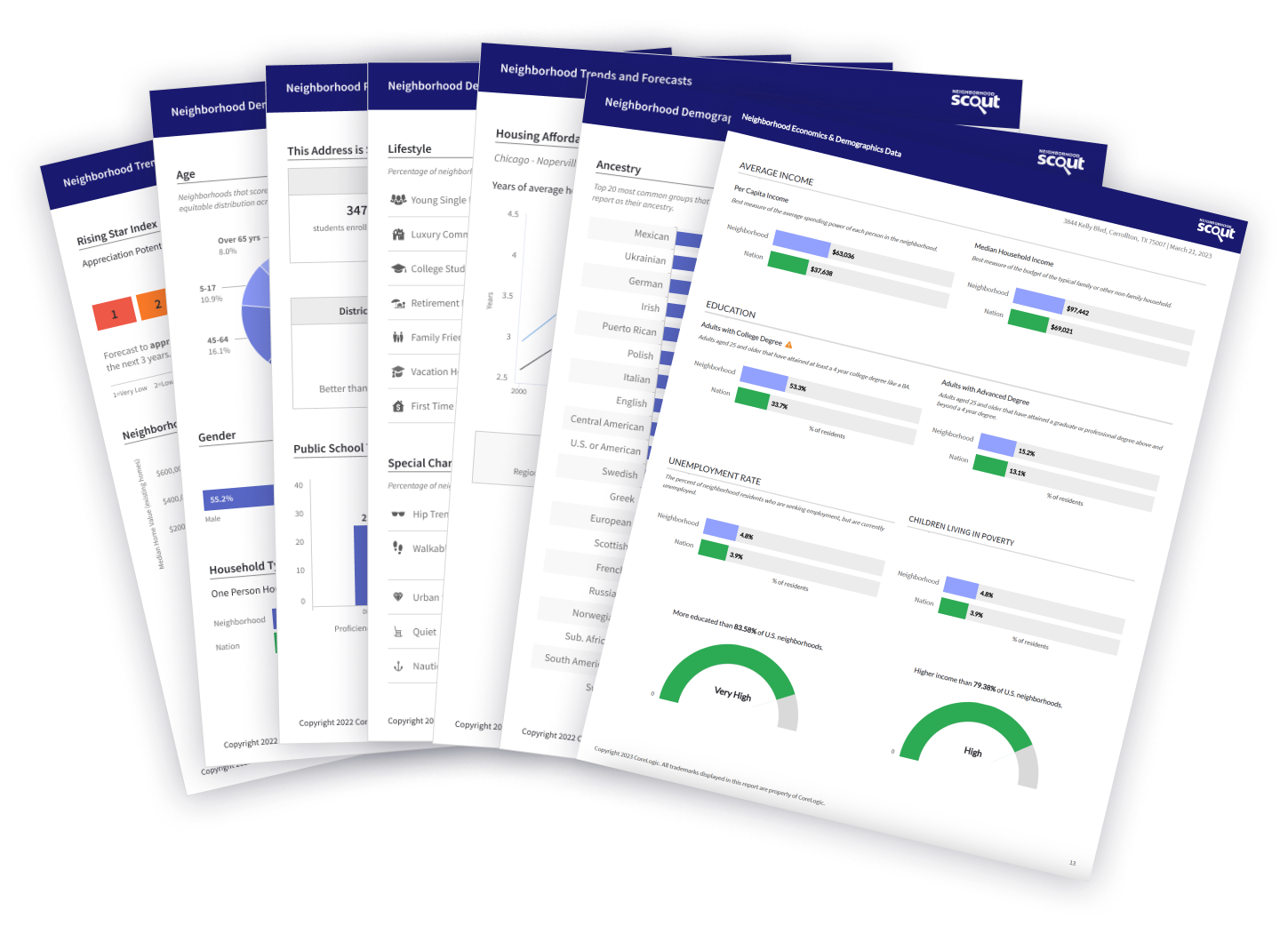
Strip District median real estate price is $561,034, which is more expensive than 88.0% of the neighborhoods in Pennsylvania and 71.3% of the neighborhoods in the U.S.
The average rental price in Strip District is currently $3,503, based on NeighborhoodScout's exclusive analysis. The average rental cost in this neighborhood is higher than 96.7% of the neighborhoods in Pennsylvania.
Strip District is a suburban neighborhood (based on population density) located in Pittsburgh, Pennsylvania.
Strip District real estate is primarily made up of small (studio to two bedroom) to medium sized (three or four bedroom) apartment complexes/high-rise apartments and single-family homes. Most of the residential real estate is renter occupied. Many of the residences in the Strip District neighborhood are newer, built in 2000 or more recently. A number of residences were also built before 1940.
Vacant apartments or homes are a major fact of life in Strip District. The current real estate vacancy rate here is 22.8%. This is higher than the rate of vacancies in 91.3% of all U.S. neighborhoods. In addition, most vacant housing here is vacant year round. This can sometimes be the case in neighborhoods dominated by new construction that is not yet occupied. But often neighborhoods with vacancy rates this high are places that can be plagued by a protracted vacancy problem. If you live here, you may find that a number of buildings in your neighborhood are actually empty.
The way a neighborhood looks and feels when you walk or drive around it, from its setting, its buildings, and its flavor, can make all the difference. This neighborhood has some really cool things about the way it looks and feels as revealed by NeighborhoodScout's exclusive research. This might include anything from the housing stock to the types of households living here to how people get around.
Of note is NeighborhoodScout's research finding that the Strip District neighborhood has some of the lowest rates of children living in poverty of any neighborhood in the United States. In a nation where approximately 1 in 4 children are living in poverty, the Strip District community truly stands out from the rest in this regard.
In addition, the types of households in a neighborhood can tell a lot about the character and lifestyle of those living here. NeighborhoodScout's exclusive analysis reveals that this neighborhood, above nearly every neighborhood in America, has a greater percentage of its residents living alone: 76.4%. This is a higher percent living alone than we found in 99.9% of all U.S. neighborhoods. Often residents who live alone are new arrivals to an area who are single, and often senior citizens who have lost a spouse.
Also, do you like to read, write, and learn? Are you curious about the world? If so, this neighborhood may be a good fit for you. NeighborhoodScout's research revealed that a full 87.4% of the adults living in the Strip District neighborhood have earned at least a bachelor's degree. This is a higher rate than NeighborhoodScout found in 99.3% of U.S. neighborhoods. In this way, this neighborhood truly stands out.
Finally, a unique characteristic about the people in the Strip District neighborhood is that a majority of them are young, single professionals. In fact, there are more young, single professionals in this one community than 97.9% of neighborhoods in the U.S. Here you'll find an active nightlife nearby with lots of opportunities to flirt and find romance. In addition to being an excellent choice for young, single professionals, this neighborhood is also a very good choice for urban sophisticates.
The Strip District neighborhood has a higher proportion of its residents employed as executives, managers and professionals than 99.6% of the neighborhoods in America. In fact, 84.2% of the employed people here make a living as an executive, a manager, or other professional. With such a high concentration, this truly shapes the character of this neighborhood, and to a large degree defines what this neighborhood is about.
The Strip District neighborhood is very unique in that it has one of the highest proportions of one, two, or no bedroom real estate of any neighborhood in America. Most neighborhoods have a mixture of home or apartment sizes from small to large, but here the concentration of studios and other small living spaces is at near-record heights. With 94.5% of the real estate here of this small size, this most assuredly is a notable feature that makes this neighborhood unique, along with just a handful of other neighborhoods in the U.S. that share this characteristic.
In addition, one of the really unique and interesting things about the look and setting of the Strip District neighborhood is that it is almost entirely dominated by large apartment buildings, such as apartment complexes or high-rise apartments. 87.0% of the residential real estate here is classified as such. This puts this neighborhood on the map as having a higher proportion of large apartment buildings than 97.8% of all neighborhoods in America.
Furthermore, renter-occupied real estate is dominant in the Strip District neighborhood. The percentage of rental real estate here, according to exclusive NeighborhoodScout analysis, is 91.2%, which is higher than 97.1% of the neighborhoods in America. If you were to buy and live in the property you bought here, you would be almost alone in doing so.
In the Strip District neighborhood, many people's commute means walking from the bedroom to the home office. NeighborhoodScout's analysis found that 39.7% of residents worked from home. This may not seem like a large number, but Scout's research shows that this is a higher percentage of people working from home than 98.1% of the neighborhoods in America. Often people who work from home are engaged in the creative or technological economy, such as is found in areas around Boston, and in Silicon Valley. Other times, people may be engaged in other businesses like trading stocks from home, or running a small beauty salon.
Also, in the Strip District neighborhood, walking to work is a real option for many. In fact, NeighborhoodScout's exclusive research reveals walking to and from work is the chosen way to commute for 13.8% of residents here. This is a higher proportion of walking commuters than we found in 96.9% of American neighborhoods. Get ready to put on your walking shoes if you move here!
Did you know that the Strip District neighborhood has more Austrian and Croatian ancestry people living in it than nearly any neighborhood in America? It's true! In fact, 3.2% of this neighborhood's residents have Austrian ancestry and 1.5% have Croatian ancestry.
Strip District is also pretty special linguistically. Significantly, 0.5% of its residents five years old and above primarily speak Persian at home. While this may seem like a small percentage, it is higher than 95.1% of the neighborhoods in America.
Some neighborhoods have more internal cohesiveness than others. While other neighborhoods feel like a collection of strangers who just happen to live near each other. Sometimes this comes down to not only the personalities of the people in a place, but how long people have been together in that neighborhood. NeighborhoodScout's research has revealed some interesting things about the rootedness of people in the Strip District neighborhood. In the Strip District neighborhood, a greater proportion of the residents living here today did not live here five years ago than is found in 97.4% of U.S. Neighborhoods. This neighborhood, more than almost any other in America, has new residents from other areas.
There are two complementary measures for understanding the income of a neighborhood's residents: the average and the extremes. While a neighborhood may be relatively wealthy overall, it is equally important to understand the rate of people - particularly children - who are living at or below the federal poverty line, which is extremely low income. Some neighborhoods with a lower average income may actually have a lower childhood poverty rate than another with a higher average income, and this helps us understand the conditions and character of a neighborhood.
The neighbors in the Strip District neighborhood in Pittsburgh are upper-middle income, making it an above average income neighborhood. NeighborhoodScout's exclusive analysis reveals that this neighborhood has a higher income than 82.2% of the neighborhoods in America. In addition, 0.0% of the children seventeen and under living in this neighborhood are living below the federal poverty line, which is a lower rate of childhood poverty than is found in 100.0% of America's neighborhoods.
A neighborhood is far different if it is dominated by enlisted military personnel rather than people who earn their living by farming. It is also different if most of the neighbors are clerical support or managers. What is wonderful is the sheer diversity of neighborhoods, allowing you to find the type that fits your lifestyle and aspirations.
In the Strip District neighborhood, 84.2% of the working population is employed in executive, management, and professional occupations. The second most important occupational group in this neighborhood is sales and service jobs, from major sales accounts, to working in fast food restaurants, with 11.2% of the residents employed. Other residents here are employed in clerical, assistant, and tech support occupations (3.0%), and 2.2% in government jobs, whether they are in local, state, or federal positions.
Languages
The most common language spoken in the Strip District neighborhood is English, spoken by 92.6% of households.
Ethnicity / Ancestry
Boston's Beacon Hill blue-blood streets, Brooklyn's Orthodox Jewish enclaves, Los Angeles' Persian neighborhoods. Each has its own culture derived primarily from the ancestries and culture of the residents who call these neighborhoods home. Likewise, each neighborhood in America has its own culture – some more unique than others – based on lifestyle, occupations, the types of households – and importantly – on the ethnicities and ancestries of the people who live in the neighborhood. Understanding where people came from, who their grandparents or great-grandparents were, can help you understand how a neighborhood is today.
In the Strip District neighborhood in Pittsburgh, PA, residents most commonly identify their ethnicity or ancestry as German (22.8%). There are also a number of people of Italian ancestry (16.1%), and residents who report Polish roots (13.8%), and some of the residents are also of Irish ancestry (13.6%), along with some Asian ancestry residents (10.9%), among others.
Even if your neighborhood is walkable, you may still have to drive to your place of work. Some neighborhoods are located where many can get to work in just a few minutes, while others are located such that most residents have a long and arduous commute. The greatest number of commuters in Strip District neighborhood spend under 15 minutes commuting one-way to work (43.1% of working residents), one of the shortest commutes across America.
Here most residents (42.5%) drive alone in a private automobile to get to work. In addition, quite a number also hop out the door and walk to work to get to work (13.8%) . In a neighborhood like this, as in most of the nation, many residents find owning a car useful for getting to work.