Carlsbad is a tiny town located in the state of Texas. With a population of 622 people and just one neighborhood, Carlsbad is the 909th largest community in Texas.
Because occupations involving physical labor dominate the local economy, Carlsbad is generally considered to be a blue-collar town. 78.47% of the Carlsbad workforce is employed in blue-collar occupations, compared to the national average of 27.7%. Overall, Carlsbad is a town of production and manufacturing workers, transportation and shipping workers, and service providers. There are especially a lot of people living in Carlsbad who work in maintenance occupations (10.76%), teaching (4.86%), and office and administrative support (3.47%).
It is a fairly quiet town because there are relatively few of those groups of people who have a tendency to be noisy. (Children, for example, often can't help themselves from being noisy, and being parents ourselves, we know!) Carlsbad has relatively few families with children living at home, and is quieter because of it. Renters and college students, for their own reasons, can also be noisy. Carlsbad has few renters and college students. But the biggest reason it is quieter in Carlsbad than in most places in America, is that there are just simply fewer people living here. If you think trees make good neighbors, Carlsbad may be for you.
One of the benefits of Carlsbad is that there is very little traffic. The average commute to work is 15.31 minutes, which is substantially less than the national average. Not only does this mean that the drive to work is less aggravating, but noise and pollution levels are lower as a result.
Being a small town, Carlsbad does not have a public transit system used by locals to get to and from work.
The population of Carlsbad has one of the lowest overall levels of education in the country: only 5.97% of people over 25 hold a college degree. The national average for all municipalities is 21.84%.
The per capita income in Carlsbad in 2022 was $11,641, which is low income relative to Texas and the nation. This equates to an annual income of $46,564 for a family of four. Carlsbad also has one of the higher rates of people living in poverty in the nation, with 46.87% of its population below the federal poverty line.
Carlsbad is an extremely ethnically-diverse town. The people who call Carlsbad home describe themselves as belonging to a variety of racial and ethnic groups. The greatest number of Carlsbad residents report their race to be White, followed by Black or African-American. Carlsbad also has a sizeable Hispanic population (people of Hispanic origin can be of any race). People of Hispanic or Latino origin account for 12.27% of the town’s residents. Important ancestries of people in Carlsbad include German, English, Scottish, Nigerian, and Irish.
The most common language spoken in Carlsbad is English. Other important languages spoken here include Spanish and Langs. of India.
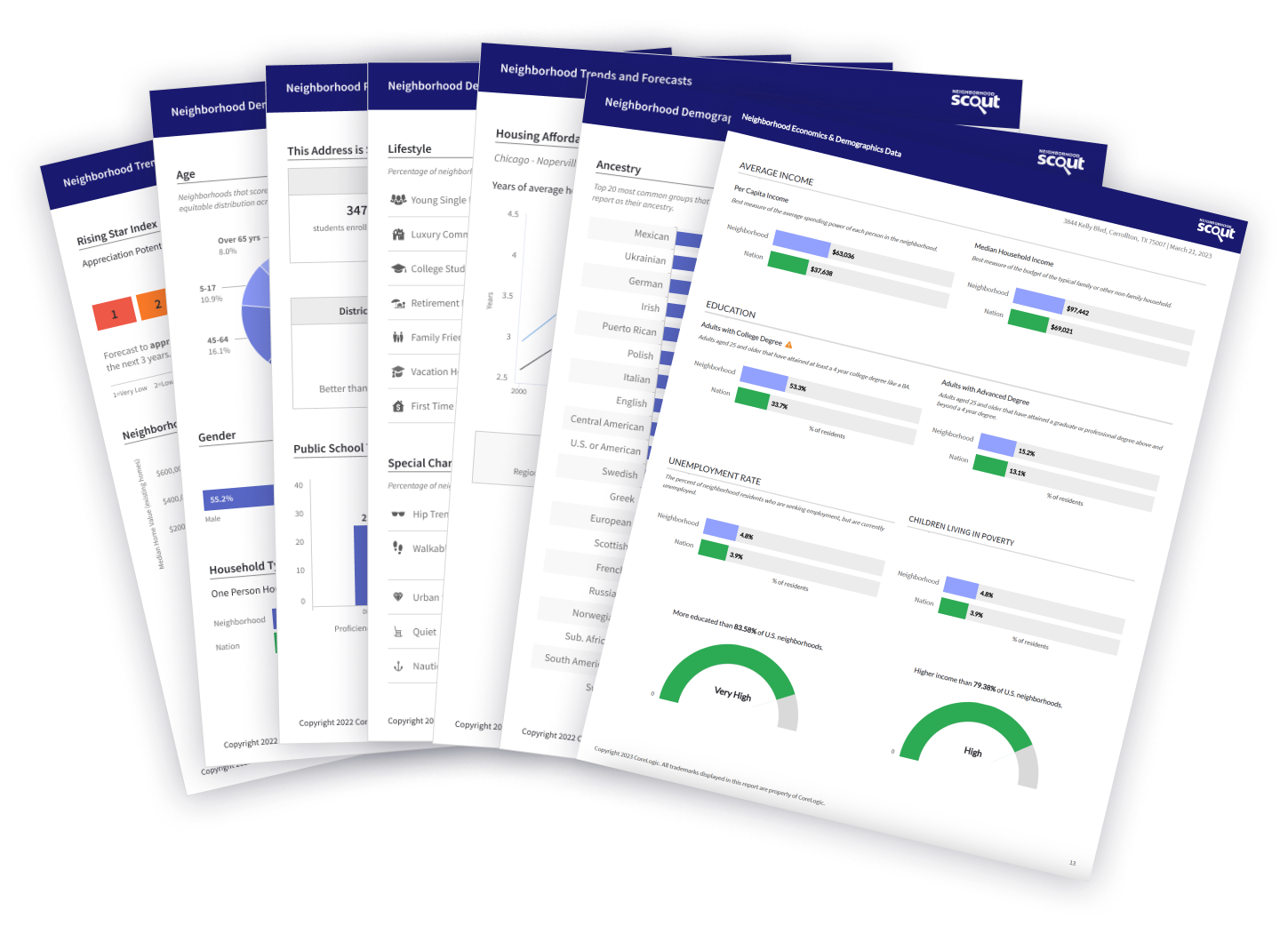
The way a neighborhood looks and feels when you walk or drive around it, from its setting, its buildings, and its flavor, can make all the difference. This neighborhood has some really cool things about the way it looks and feels as revealed by NeighborhoodScout's exclusive research. This might include anything from the housing stock to the types of households living here to how people get around.
Uncrowded roads, rural America and space to be the individual you are. If you like these characteristics, this neighborhood may fit you. With just 13 residents per square mile, is less crowded than 96.3% of all U.S. neighborhoods.
Whether walking, biking, riding, or driving, the length of one's commute is an important factor for one's quality of life. The neighborhood stands out for its commute length, according to NeighborhoodScout's analysis. Long commutes can be brutal. They take time, money, and energy, leaving less of you for yourself and your family. The residents of the neighborhood unfortunately have the distinction of having, on average, a longer commute than most any neighborhood in America. 9.5% of commuters here travel more than one hour just one-way to work. That is more than two hours per day. This percentage with two-hour + round-trip commutes is higher than NeighborhoodScout found in 95.1% of all neighborhoods in America.
Did you know that the neighborhood has more Dutch ancestry people living in it than nearly any neighborhood in America? It's true! In fact, 3.4% of this neighborhood's residents have Dutch ancestry.
There are two complementary measures for understanding the income of a neighborhood's residents: the average and the extremes. While a neighborhood may be relatively wealthy overall, it is equally important to understand the rate of people - particularly children - who are living at or below the federal poverty line, which is extremely low income. Some neighborhoods with a lower average income may actually have a lower childhood poverty rate than another with a higher average income, and this helps us understand the conditions and character of a neighborhood.
The neighbors in the neighborhood in Carlsbad are upper-middle income, making it an above average income neighborhood. NeighborhoodScout's exclusive analysis reveals that this neighborhood has a higher income than 64.4% of the neighborhoods in America. In addition, 2.7% of the children seventeen and under living in this neighborhood are living below the federal poverty line, which is a lower rate of childhood poverty than is found in 72.0% of America's neighborhoods.
A neighborhood is far different if it is dominated by enlisted military personnel rather than people who earn their living by farming. It is also different if most of the neighbors are clerical support or managers. What is wonderful is the sheer diversity of neighborhoods, allowing you to find the type that fits your lifestyle and aspirations.
In the neighborhood, 35.5% of the working population is employed in executive, management, and professional occupations. The second most important occupational group in this neighborhood is manufacturing and laborer occupations, with 33.8% of the residents employed. Other residents here are employed in sales and service jobs, from major sales accounts, to working in fast food restaurants (21.5%), and 9.1% in clerical, assistant, and tech support occupations.
The most common language spoken in the neighborhood is English, spoken by 82.2% of households. Some people also speak Spanish (17.0%).
Culture is shared learned behavior. We learn it from our parents, their parents, our houses of worship, and much of our culture – our learned behavior – comes from our ancestors. That is why ancestry and ethnicity can be so interesting and important to understand: places with concentrations of people of one or more ancestries often express those shared learned behaviors and this gives each neighborhood its own culture. Even different neighborhoods in the same city can have drastically different cultures.
In the neighborhood in Carlsbad, TX, residents most commonly identify their ethnicity or ancestry as Mexican (24.6%). There are also a number of people of German ancestry (18.4%), and residents who report Irish roots (9.9%), and some of the residents are also of English ancestry (8.9%), along with some Dutch ancestry residents (3.4%), among others.
How you get to work – car, bus, train or other means – and how much of your day it takes to do so is a large quality of life and financial issue. Especially with gasoline prices rising and expected to continue doing so, the length and means of one's commute can be a financial burden. Some neighborhoods are physically located so that many residents have to drive in their own car, others are set up so many walk to work, or can take a train, bus, or bike. The greatest number of commuters in neighborhood spend between 15 and 30 minutes commuting one-way to work (52.4% of working residents), which is shorter than the time spent commuting to work for most Americans. However, there is also a significant group of residents (9.5%) who commute over an hour in each direction.
Here most residents (77.8%) drive alone in a private automobile to get to work. In addition, quite a number also hop out the door and walk to work to get to work (6.8%) and 5.5% of residents also carpool with coworkers, friends, or neighbors for their daily commute. In a neighborhood like this, as in most of the nation, many residents find owning a car useful for getting to work.