Charlotte is a very small town located in the state of Vermont. With a population of 3,897 people and just one neighborhood, Charlotte is the 49th largest community in Vermont.
Charlotte home prices are not only among the most expensive in Vermont, but Charlotte real estate also consistently ranks among the most expensive in America.
Charlotte is a decidedly white-collar town, with fully 86.72% of the workforce employed in white-collar jobs, well above the national average. Overall, Charlotte is a town of managers, professionals, and sales and office workers. There are especially a lot of people living in Charlotte who work in management occupations (22.91%), business and financial occupations (13.42%), and office and administrative support (8.93%).
Also of interest is that Charlotte has more people living here who work in computers and math than 95% of the places in the US.
One interesting thing about the economy is that relatively large numbers of people worked from their home: 29.77% of the workforce. While this number may seem small overall, as a fraction of the total workforce this is high compared to the rest of the county. These workers are often telecommuters who work in knowledge-based, white-collar professions. For example, Silicon Valley has large numbers of people who telecommute. Other at-home workers may be self-employed people who operate small businesses out of their homes.
In addition, Charlotte is home to many people who could be described as "urban sophisticates". Urban sophisticates are educated, wealthy, executives and professionals, who have urbane tastes in books, food, and travel, whether they actually live in a big city, or choose to reside in a small town. In big or medium-sized cities, urban sophisticates tend to frequent art institutions such as opera, symphonies, ballet, live theatre, and museums.
Charlotte is a good choice for families with children because of several factors. Many other families with children live here, making it a place where both parents and children are more likely to develop social ties with other families. The town’s good public school district and large population of college-educated adults provide an environment conducive to academic success. Many people own their own single-family homes, providing areas for children to play and stability in the community. Finally, Charlotte’s overall crime rate is lower than average for the country.
Residents will find that the town is relatively quiet. This is because it is not over-populated, and it has fewer college students, renters, and young children - all of whom can be noisy at times. So, if you're looking for a relatively peaceful place to live, Charlotte is worth considering.
As is often the case in a small town, Charlotte doesn't have a public transportation system that people use for their commute.

Do you have a 4-year college degree or graduate degree? If so, you may feel right at home in Charlotte. 66.23% of adults here have a 4-year degree or graduate degree, whereas the national average for all cities and towns is just 21.84%.
The per capita income in Charlotte in 2022 was $83,330, which is wealthy relative to Vermont and the nation. This equates to an annual income of $333,320 for a family of four.
The people who call Charlotte home describe themselves as belonging to a variety of racial and ethnic groups. The greatest number of Charlotte residents report their race to be White, followed by Asian. Important ancestries of people in Charlotte include English, Irish, German, Italian, and Scottish.
The most common language spoken in Charlotte is English. Other important languages spoken here include Polish and Spanish.
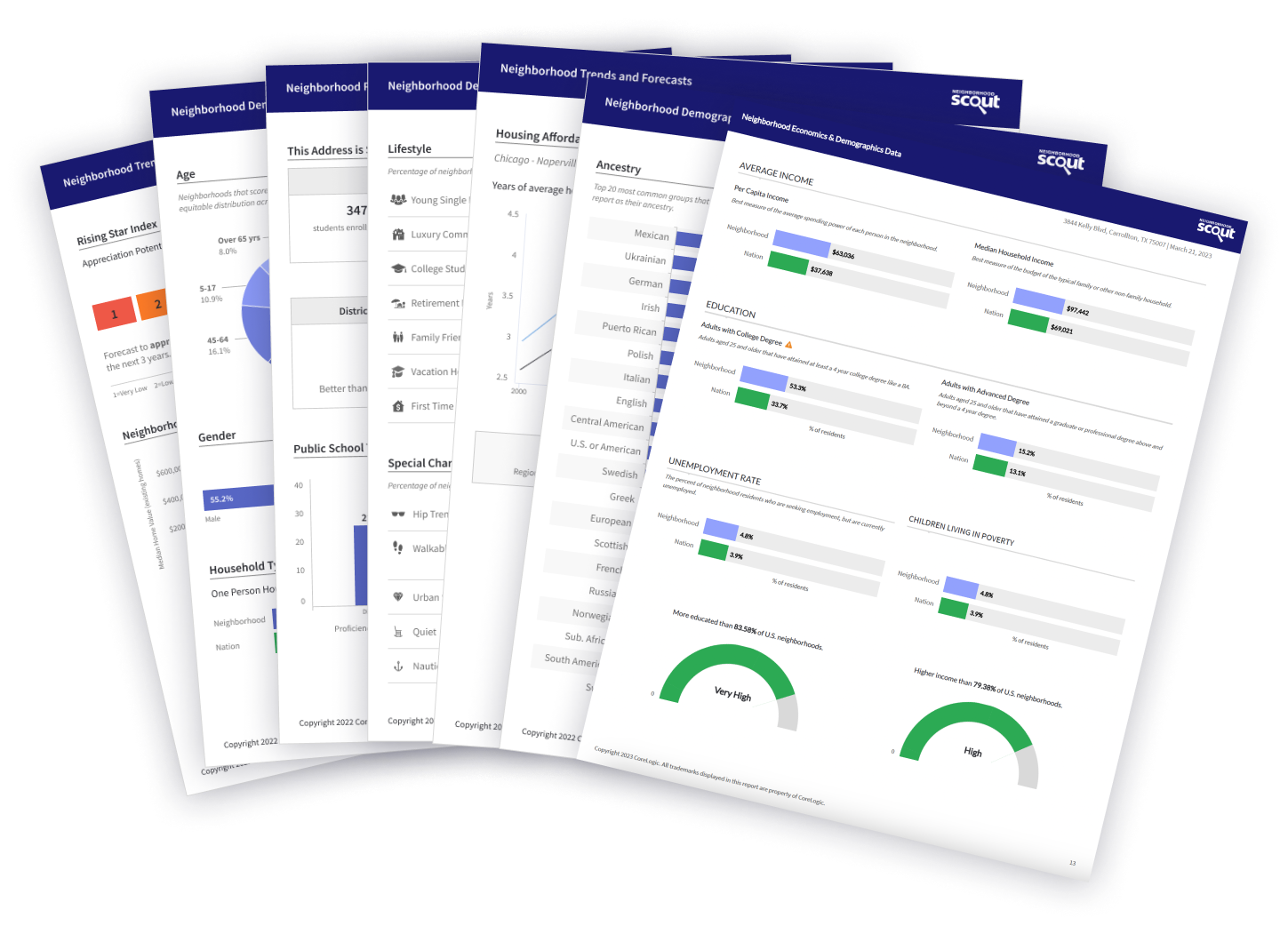
Many things matter about a neighborhood, but the first thing most people notice is the way a neighborhood looks and its particular character. For example, one might notice whether the buildings all date from a certain time period or whether shop signs are in multiple languages. This particular neighborhood in Charlotte, the neighborhood, has some outstanding things about the way it looks and its way of life that are worth highlighting.
A majority of the adults in the neighborhood are wealthy and educated executives. They own stately homes that tend to maintain high real estate appreciation rates. Their upper-level careers keep them busy, but allow them to live comfortably. If you're an executive and want to keep similar company, consider settling in this neighborhood, rated as an executive lifestyle "best choice" neighborhood for Vermont by NeighborhoodScout's analysis, which rated it as better for executive lifestyles than 98.4% of the neighborhoods in Vermont. In addition to being an excellent choice for highly educated executives, this neighborhood is also a very good choice for urban sophisticates and families with school-aged children.
In addition, if knowledge is power, then imagine the cumulative power of one neighborhood where many of the adults have earned an advanced degree, such as a Masters, law degree, medical degree, or even a Ph.D. This is certainly the case in the neighborhood, where 36.9% have earned an advanced degree. Compare that to the average neighborhood in America, where just 14.1% of adults have completed a post-graduate degree, and you can see why this neighborhood is a stand out. In fact, this neighborhood has a higher rate of adults with an advanced degree than 95.5% of the neighborhoods in America.
One of the notable things about is that it is one of the quietest neighborhoods in America, according to NeighborhoodScout's exclusive analysis and quantitative rating of quietness. When you are here, you will find it to be very quiet. If quiet and peaceful are your cup of tea, you may have found a great place for you.
In addition, owner-occupied real estate dominates the neighborhood. In fact, according to NeighborhoodScout research, the percentage of residential real estate occupied by its owner is higher here than in 96.7% of neighborhoods in America.
Did you know that the neighborhood has more French Canadian and Canadian ancestry people living in it than nearly any neighborhood in America? It's true! In fact, 5.2% of this neighborhood's residents have French Canadian ancestry and 1.6% have Canadian ancestry.
There are two complementary measures for understanding the income of a neighborhood's residents: the average and the extremes. While a neighborhood may be relatively wealthy overall, it is equally important to understand the rate of people - particularly children - who are living at or below the federal poverty line, which is extremely low income. Some neighborhoods with a lower average income may actually have a lower childhood poverty rate than another with a higher average income, and this helps us understand the conditions and character of a neighborhood.
The neighbors in the neighborhood in Charlotte are wealthy, making it among the 15% highest income neighborhoods in America. NeighborhoodScout's exclusive analysis reveals that this neighborhood has a higher income than 90.9% of the neighborhoods in America. In addition, 3.9% of the children seventeen and under living in this neighborhood are living below the federal poverty line, which is a lower rate of childhood poverty than is found in 67.4% of America's neighborhoods.
What we choose to do for a living reflects who we are. Each neighborhood has a different mix of occupations represented, and together these tell you about the neighborhood and help you understand if this neighborhood may fit your lifestyle.
In the neighborhood, 65.4% of the working population is employed in executive, management, and professional occupations. The second most important occupational group in this neighborhood is manufacturing and laborer occupations, with 11.9% of the residents employed. Other residents here are employed in sales and service jobs, from major sales accounts, to working in fast food restaurants (11.9%), and 9.4% in clerical, assistant, and tech support occupations.
The languages spoken by people in this neighborhood are diverse. These are tabulated as the languages people preferentially speak when they are at home with their families. The most common language spoken in the neighborhood is English, spoken by 90.5% of households. Other important languages spoken here include Polish and Spanish.
Culture is the shared learned behavior of peoples. Undeniably, different ethnicities and ancestries have different cultural traditions, and as a result, neighborhoods with concentrations of residents of one or another ethnicities or ancestries will express those cultures. It is what makes the North End in Boston so fun to visit for the Italian restaurants, bakeries, culture, and charm, and similarly, why people enjoy visiting Chinatown in San Francisco.
In the neighborhood in Charlotte, VT, residents most commonly identify their ethnicity or ancestry as English (22.5%). There are also a number of people of Irish ancestry (15.7%), and residents who report German roots (8.9%), and some of the residents are also of Italian ancestry (5.6%), along with some Scottish ancestry residents (5.6%), among others. In addition, 12.5% of the residents of this neighborhood were born in another country.
Even if your neighborhood is walkable, you may still have to drive to your place of work. Some neighborhoods are located where many can get to work in just a few minutes, while others are located such that most residents have a long and arduous commute. The greatest number of commuters in neighborhood spend between 15 and 30 minutes commuting one-way to work (45.4% of working residents), which is shorter than the time spent commuting to work for most Americans.
Here most residents (56.9%) drive alone in a private automobile to get to work. In addition, quite a number also carpool with coworkers, friends, or neighbors to get to work (10.0%) . In a neighborhood like this, as in most of the nation, many residents find owning a car useful for getting to work.